
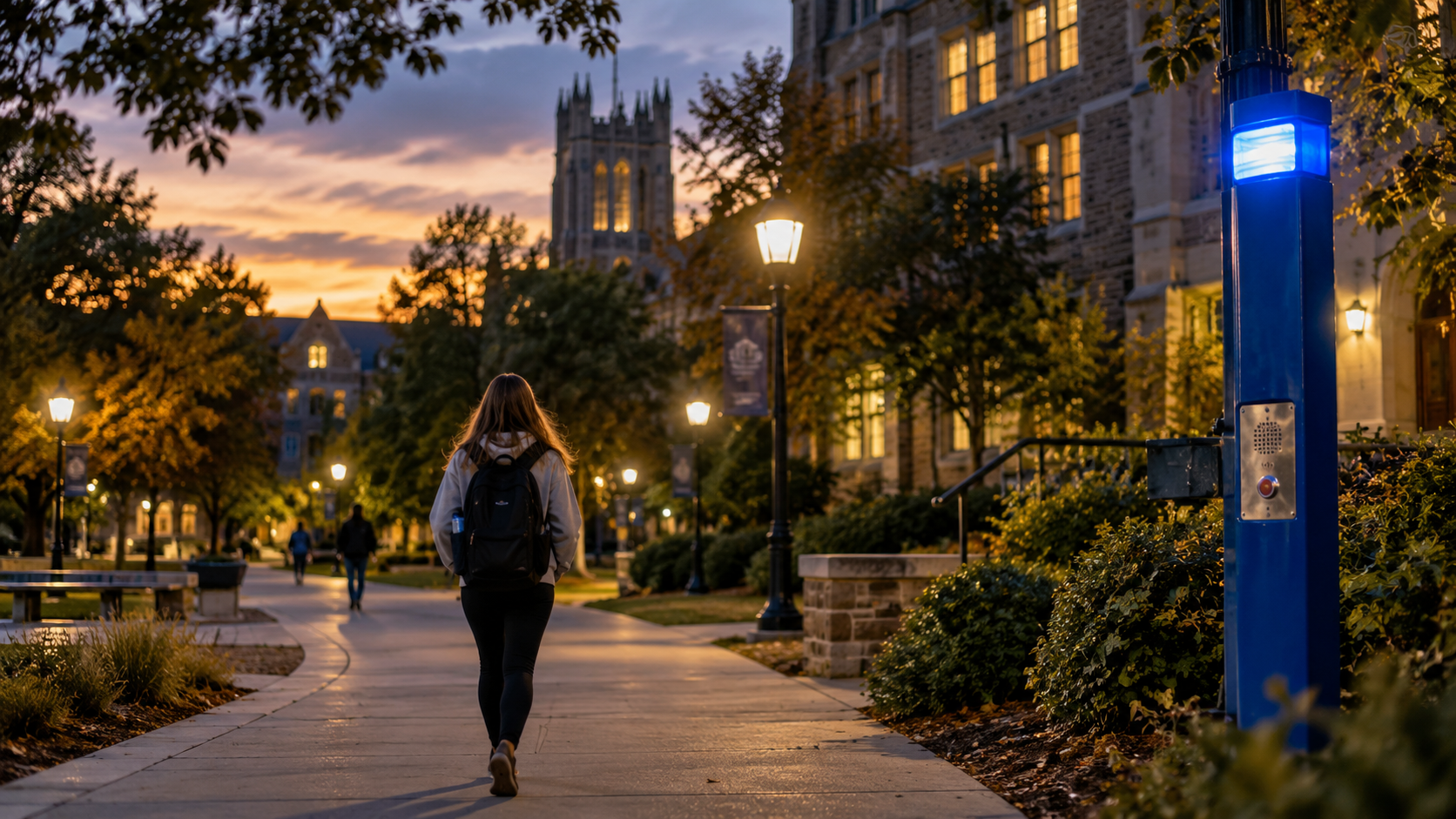
I started looking into college campus safety for a pretty simple reason: I’m a father.
That alone should probably explain why I can turn a perfectly innocent college search into something resembling an FBI background investigation. Parents have that talent. The school sees beautiful buildings, green lawns and smiling students carrying backpacks. We see our child walking across that same campus at 11:30 at night wondering why she didn’t call somebody for a ride.
So I started asking what I thought was a simple question: Which colleges are the safest?
It turns out that isn’t such a simple question.
Colleges and universities publish annual security reports under the federal Clery Act. Those reports include certain crimes reported on campus and surrounding areas, including homicide, robbery, aggravated assault, sexual offenses, burglary and other categories. Schools with on-campus housing are also required to have procedures for handling reports of missing residential students. (Radford University)
But here is something I didn’t realize when I started looking: colleges are not required to publish a nice little column that says, “Number of students who disappeared this year.”
I looked.
Trust me, if there had been a spreadsheet, I would have found it.
Instead, missing-student cases are handled through notification and investigative procedures. Roanoke College, for example, requires Campus Safety to be notified immediately when someone has information that a residential student may be missing. If the student is determined to be missing, the appropriate law-enforcement agency must be notified within 24 hours. (Roanoke College) UVA follows a similar process involving university police, Student Affairs and, when necessary, outside law enforcement. (UVA Clery Act)
That distinction matters because being “reported missing” and truly disappearing are two very different things.
A student might stay overnight somewhere unexpected, lose a phone, ignore everybody for a few hours or simply forget that parents apparently possess an internal clock that begins screaming approximately six minutes after a text goes unanswered.
Those situations usually end well.
Unfortunately, some do not.
Virginia has experienced several heartbreaking cases involving college students. In 2009, Virginia Tech student Morgan Harrington disappeared after leaving a concert in Charlottesville. Her remains were discovered the following January on a farm outside the city. The FBI later worked with Virginia State Police and other agencies investigating her murder. (FBI)
Another Virginia Tech student, Robert Kovack, disappeared in 1998 while traveling home to West Virginia. His vehicle was found near the New River Gorge Bridge. More than 17 years later, remains discovered beneath the bridge were identified through DNA as Kovack’s. Investigators said evidence suggested he may have been struck by a vehicle before falling from the bridge. (WV MetroNews)
In 2014, University of Virginia student Hannah Graham disappeared in Charlottesville. UVA today maintains a memorial site honoring the 18-year-old second-year student and the life she lived before it was taken from her. (Hannah Graham)
These stories are frightening. They should be.
But they also need perspective.
Cases like these are memorable partly because they are unusual. Tens of thousands of young adults attend Virginia colleges every year, and the overwhelming majority go to class, make friends, complain about cafeteria food, stay up much too late and eventually come home safely.
That doesn’t mean parents should ignore safety. It means we should understand what campus safety can and cannot accomplish.
A college can lock residence halls. It can provide campus police, emergency alerts, cameras, lighting, escorts and transportation. It can teach students how to protect themselves and respond quickly when someone is reported missing.
What it cannot do is place a security officer beside every student every minute of every day.
Eventually our children leave the dorm. They go downtown. They attend concerts. They visit friends. They travel. They meet people we have never met.
And somewhere in all of that, responsibility begins shifting.
I hesitate to call that “poor decision-making,” because that can too easily sound like blaming a victim when something terrible happens. Nobody deserves to become the victim of a crime because they trusted the wrong person, walked somewhere alone or made a mistake.
But there is still a lesson worth teaching.
Know where you are. Know who you are with. Have a way home. Use the campus escort if something doesn’t feel right. Tell somebody where you’re going. Keep your phone charged. Watch out for your friends.
And perhaps the hardest one: if that little voice in your head says something feels wrong, listen to it.
Parents spend years trying to protect their children. We lock doors, check on them, worry when they’re late and occasionally deliver speeches that our children have already heard approximately 147 times.
Then one day we take them to college.
We unload the car, carry boxes into a dorm room and eventually have to drive away.
That may be the real campus-safety story.
The safest college in America cannot replace good judgment, awareness and communication. And the most careful parent in America eventually has to loosen the grip and trust that the lessons made it through.
So maybe the question isn’t simply, “Which college is safest?”
Maybe the better question is:
Have we taught our children how to help keep themselves safe when we are no longer standing beside them?
By J Jones
Leave a Reply