
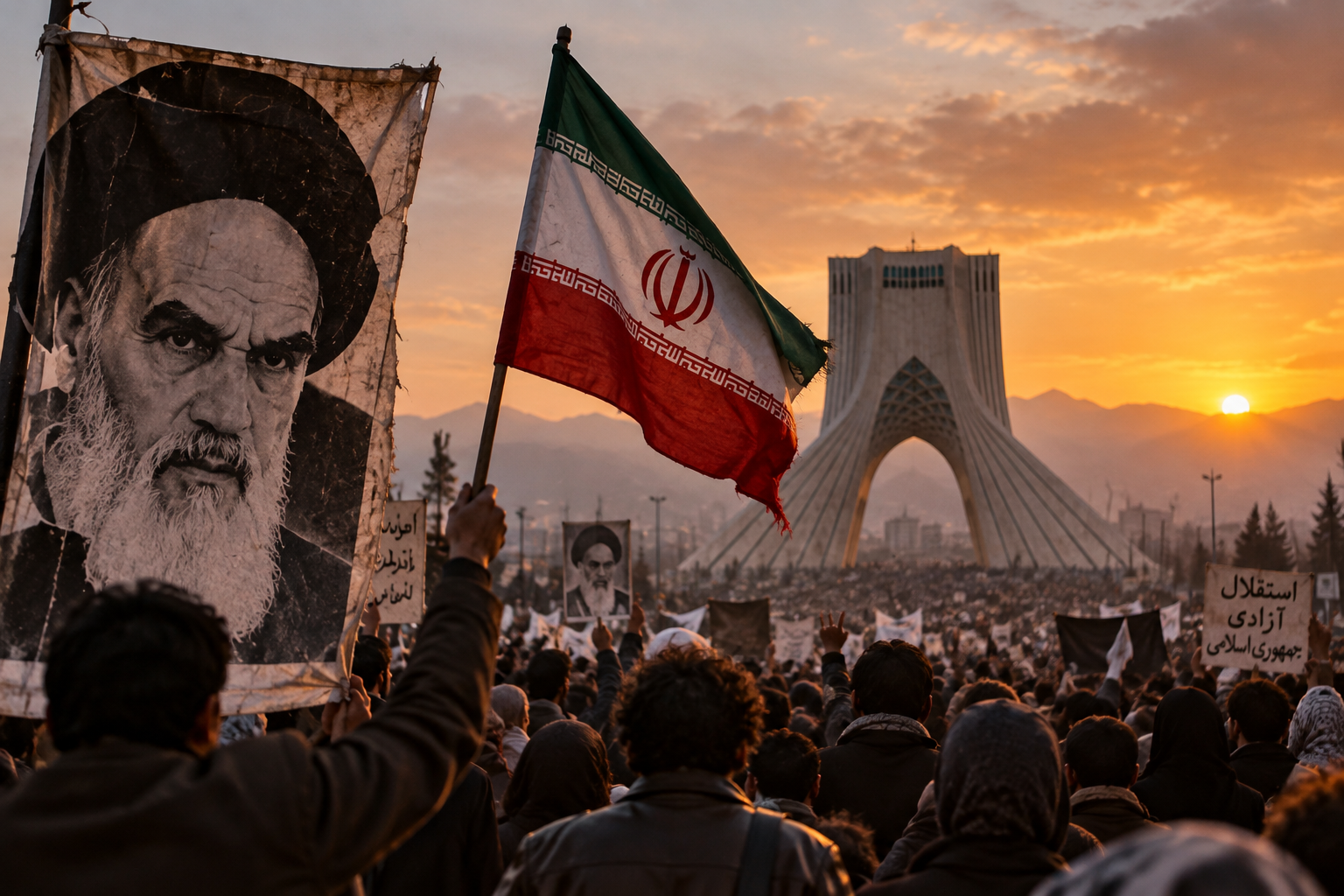
History usually looks a lot cleaner after the fact than it did while people were actually living through it. Revolutions are especially good at that. Years later, we draw neat little lines between events and act like everyone should have known exactly where things were headed. If history were really that easy, we would probably make a lot fewer mistakes.
The Iranian Revolution of 1979 is a good example.
Ayatollah Ruhollah Khomeini became the face of the movement that overthrew Shah Mohammad Reza Pahlavi. The Shah was authoritarian, and opposition to him came from several directions: religious conservatives, liberals, nationalists, leftists, students and ordinary citizens who simply wanted political change. That coalition mattered because not everyone standing on the same side of the street was headed to the same destination.
Years before the revolution, Khomeini had already laid out a very specific vision of government. In lectures given in Najaf in 1970, later published as Islamic Government, he argued that Islamic jurists should exercise political authority. The doctrine became known as velayat-e faqih, or guardianship of the Islamic jurist. So the idea of clerical rule did not suddenly fall out of the sky after the Shah was gone. It was already there.
But something changed in the way Khomeini spoke publicly as the revolution approached.
During his exile in France in 1978, he emphasized elections, freedom and popular choice. In a November 1978 interview reported by The Washington Post, Khomeini said the Iranian people would choose their government through universal suffrage. He also said he had no intention of heading the government or becoming part of it. Now, I am no constitutional scholar, but that sounds quite a bit different from building a system where the highest political authority belongs to a religious jurist.
And apparently some of Khomeini’s own allies heard the difference too.
Mehdi Bazargan, a respected opposition leader and later the first prime minister after the Shah fell, supported the revolution but did not support supreme clerical government. Encyclopaedia Iranica reports that Bazargan and his Freedom Movement mistakenly believed Khomeini no longer supported velayat-e faqih. They expected him to serve more as a spiritual or general leader than as the ultimate political authority.
That may be one of the most important pieces of this entire story. These were not simply people who supported the revolution and then got cold feet when things became difficult. Some of them appear to have believed they were helping create a government fundamentally different from the one that eventually emerged.
Bazargan’s provisional government prepared an early draft constitution that did not contain the later system of supreme clerical rule. The structure was much closer to a conventional republic, with elected officials holding greater authority and religious oversight far more limited.
Then things changed, and not in a small-print-at-the-bottom-of-the-contract kind of way.
An Assembly of Experts dominated by clerics rewrote the proposed constitution. Encyclopaedia Iranica says the earlier draft was altered “beyond recognition.” The new constitution placed velayat-e faqih at the center of the political system, giving enormous authority to the supreme religious jurist.
At roughly the same time, the political atmosphere was changing too. Opposition newspapers were closed. Liberal and secular groups that had helped overthrow the Shah began losing influence. Bazargan and others became increasingly frustrated that the provisional government had authority on paper but far less control over the revolutionary institutions actually shaping the country. Having a title is one thing. Having the power that supposedly comes with it is another.
By November 1979, Bazargan resigned. The revolution he had helped support was no longer becoming the government he thought he had been helping to build.
Abolhassan Bani-Sadr followed a similar path. He had been close to Khomeini during exile and became the Islamic Republic’s first elected president. Yet he eventually came into conflict with the clerical leadership over the growing power of religious institutions. He was removed from office in 1981 and fled Iran. Once again, people who had helped overthrow the old government ended up opposing the system that replaced it.
That brings us to the uncomfortable question: were they deceived?
History does not give us a single document in which Khomeini writes, “I will tell these people one thing until I have power and then do another.” History almost never makes things that convenient. Without that kind of evidence, it would be irresponsible to claim that his private intentions have been proven.
But the documented record still shows something important. Khomeini had already written about clerical government years before the revolution. During the critical period when he needed broad public support, he emphasized elections, popular sovereignty and a limited personal political role. Some of his major allies apparently believed those statements and expected a government without supreme clerical control. After the revolution succeeded, the political system moved much closer to the model Khomeini had described years earlier.
That does not automatically prove a secret plan, but it does give us a reason to ask whether everyone standing beside him understood what they were helping create.
There is another part of the story that deserves attention. Once Khomeini was in power, political crises repeatedly strengthened the clerical leadership. Contemporary American diplomatic reports observed that conflicts such as the Kurdish uprising allowed Khomeini to rally support, restrict opposition and strengthen his authority. The American hostage crisis later intensified internal political struggles and helped weaken liberal and moderate factions.
That does not mean Khomeini created every crisis. Sometimes history hands political leaders a crisis whether they want one or not. The more revealing question is what they do with it, and Khomeini and his allies proved very effective at turning turmoil into political advantage.
That may be the larger lesson in all of this. Political movements are often judged by what they promise before gaining power, but history judges them by what they do afterward. In Iran, the distance between those two moments was enormous. Many people believed they were helping overthrow an authoritarian monarchy and build a republic influenced by Islam. What emerged was a system in which religious authority stood above elected political institutions, and some of the very people who helped make the revolution possible eventually found themselves pushed aside by it.
There is something painfully human in that. People can become so focused on tearing down what they oppose that they do not always ask enough questions about what is waiting to replace it. In Iran, that question mattered enormously, because by the time some of Khomeini’s early allies fully understood the direction the revolution was taking, the balance of power had already shifted.
Maybe the most important question, then, is not simply whether these leaders supported Khomeini. We already know they did. The better question is whether they truly understood what they were supporting, and whether the government they helped bring into being was the government they believed they were being promised.
References
Encyclopaedia Iranica, “Khomeini II: Works”
https://www.iranicaonline.org/articles/khomeini-ii-works/
Encyclopaedia Iranica, “Khomeini I: Life”
https://www.iranicaonline.org/articles/khomeini-i-life/
Encyclopaedia Iranica, “Constitution of the Islamic Republic”
https://www.iranicaonline.org/articles/constitution-of-the-islamic-republic/
Encyclopaedia Iranica, “Islamic Political Movements in 20th-Century Iran”
https://www.iranicaonline.org/articles/islam-in-iran-xiii-islamic-political-movements-in-20th-century-iran/
Encyclopaedia Iranica, “Hostage Crisis”
https://www.iranicaonline.org/articles/hostage-crisis/
The Washington Post, November 7, 1978, reporting Khomeini’s comments on universal suffrage and his future political role
https://www.washingtonpost.com/archive/politics/1978/11/07/military-cracks-down-on-rebels-in-iran/75800364-a814-487e-a420-ad9165698a80/
U.S. Department of State, Foreign Relations of the United States, 1977–1980, Volume XI, Part 1, Document 37
https://history.state.gov/historicaldocuments/frus1977-80v11p1/d37
U.S. Department of State, Foreign Relations of the United States, 1977–1980, Volume XI, Part 1, Document 94
https://history.state.gov/historicaldocuments/frus1977-80v11p1/d94
U.S. Department of State, Foreign Relations of the United States, 1977–1980, Volume XI, Part 1, Document 281
https://history.state.gov/historicaldocuments/frus1977-80v11p1/d281
By J Jones