Words have the power to lift us up, break us down, inspire us and create dreams. Where will ours take us?

Featured Stories
-

The People Who Never Left Jim Croce
By J Jones
A note from the author: This isn’t meant to be a biography of Jim Croce. It’s written from the memories of a kid who loved his music, mixed with the stories and little pieces of Croce’s life I’ve picked up over the years. Memory isn’t perfect—especially after more than half a century—so if I got something wrong, tell me. Correct me, add something I missed or share your own memory of Jim Croce in the comments. I’d actually enjoy the conversation.
I was ten years old when Jim Croce died in 1973. I remember waiting for his songs to come on the radio, which probably sounds strange to anyone who grew up with every song ever recorded sitting inside a phone. Back then, if you wanted to hear Jim Croce, you waited for the DJ to cooperate. There was no search button and no playlist waiting for you. When one of his songs finally came through that little radio speaker, you listened.
I did anyway, and more than fifty years later I still do.
I’ve tried to explain Jim Croce to my children, with mixed results. I have five children I have raised or am raising, so I’ve become pretty good at recognizing that look children give a father when he’s explaining something they have already decided isn’t nearly as important as he thinks it is. I can almost hear the unspoken response: Yeah, okay, Dad. Who cares?
I do, and maybe that’s what I’ve been trying to explain all along.
There have been thousands of singers since Croce died. Some had bigger voices, longer careers and far more time to build a legacy. Yet for reasons I can’t completely explain, Croce’s music found a home inside me. His songs became part of my life, and somewhere along the way I stopped needing to understand why.
Maybe that’s one of the greatest things music can do. A musician you’ve never met can write something years ago, you hear it at exactly the right moment, and somehow part of that person comes along with you.
The funny thing is, Croce seems to have done something very similar with the people he encountered in his own life.
It’s easy today to hear “Operator,” “Time in a Bottle,” “You Don’t Mess Around with Jim” or “Bad, Bad Leroy Brown” and think of Jim Croce as the successful singer-songwriter behind them. What gets lost is how long it took him to become that man. Croce spent years trying to make music work. He performed with his wife, Ingrid, recorded an album with her, played bars and worked ordinary jobs while trying to support himself.
He drove trucks and worked construction. He knew what it was like to have a dream that wasn’t paying the bills.
I understand a little something about driving trucks, and maybe that gives me another connection to him. Spend enough time working around truck drivers, dockworkers, mechanics and people you meet along the road and you accumulate characters. Believe me, you accumulate characters. Some become friends, some become stories, and a few make you wonder how they managed to reach adulthood without adult supervision.
Croce paid attention to people like that.
One of the best examples became “Bad, Bad Leroy Brown.” The man who helped inspire Leroy wasn’t some character dreamed up in a songwriter’s office. Croce said he met him while they were in telephone-lineman school at Fort Dix during his National Guard service. According to Croce’s telling, the man decided after about a week that military life wasn’t for him and went AWOL. Then, in a decision that suggests Leroy may already have been Leroy, he came back around payday looking for his check and was arrested.
Jim Croce remembered him.
Years later, that memory helped become “Bad, Bad Leroy Brown,” the song that gave Croce his first No. 1 single. There is something almost perfect about that. Croce took an ordinary man he met during an ordinary part of his life and gave him a kind of immortality. Most of us would have told the story a few times and eventually forgotten it. Croce put his version of the character into a song, and people are still singing about Leroy today.
Leroy wasn’t alone. Croce had an ability to notice people and turn what he saw into stories. That may be one reason his songs have always felt so human to me. These weren’t perfect people living perfect lives. They were tough guys, lonely people, lovers, losers and people trying to figure things out. In other words, they were us.
His success didn’t arrive quickly either. You Don’t Mess Around with Jim finally broke through in 1972, when Croce was 29. By then he had spent years working, performing and wondering whether music was ever going to become more than a dream. Around that period, with a young family and another mouth to feed, he made another serious push at songwriting. Some of the songs we now associate most closely with him came out of an astonishingly productive period.
That’s something I appreciate more today than I ever could when I first heard him. When you’re young, you hear the song. After you’ve lived awhile, you start hearing the struggle behind it.
You understand what it means to keep chasing something while life keeps reminding you that the electric bill doesn’t particularly care about your dreams.
Then Croce finally caught his.
America knew his name. His songs were climbing the charts, people were buying his records, and the years of struggling seemed to have finally paid off. On September 20, 1973, after performing at Northwestern State University in Natchitoches, Louisiana, Croce boarded a chartered plane with five other people, including his guitarist Maury Muehleisen. The plane crashed shortly after takeoff. Everyone aboard was killed.
Croce was only 30.
I remember the loss, although I probably understood it differently then than I do today. What I knew was simple: someone whose music mattered to me was suddenly gone. There would be no long Jim Croce career to follow, no decades of new albums and no chance to see what kind of songwriter he might become as he grew older.
That’s one of the things that still gets me. He worked so long to get there and had so little time once he arrived.
Yet maybe time isn’t the only way we measure a life in music.
I can listen to Croce today and something still happens. A few notes can carry me backward faster than any photograph. I remember radios, places, feelings and a world that doesn’t exist quite the way it did then. That’s difficult to explain to somebody who doesn’t have the same connection to the music, and maybe that’s why my children occasionally give me that Dad is talking about old music again look.
That’s okay. Someday they’ll probably understand, although their Jim Croce will likely have a different name.
Eventually most of us find a song, a singer, a book or maybe just a voice that attaches itself to a piece of our lives. Years pass and everything around us changes, but somehow that one thing can still take us back. You don’t decide that it’s going to happen. It just does.
Perhaps that’s why I keep thinking about Jim Croce.
He noticed people. He carried pieces of them with him and turned some of those pieces into songs. People like the man who helped inspire Leroy Brown probably had no idea that an encounter with Croce might someday echo through millions of radios and record players.
And in a very different way, Croce did something similar to me.
I never met him. He never knew my name. I was simply a kid waiting for one of his songs to come on the radio. Yet something he created crossed all that distance between us and stayed with me for more than half a century.
I think that’s what artists hope for when everything else is stripped away. Not simply a No. 1 record or a sold-out room, but the chance to create something that becomes part of another person’s life.
Jim Croce did that for me.
His music found a home inside me a long time ago. I still can’t completely explain why.
But maybe the fact that it’s still there is explanation enough.
Were you a Jim Croce fan? What do you remember about him—or which song found a home in you? Tell me in the comments.
-

Whose Life Is She Allowed to Live?
By J Jones
I have watched news clips of women attacked with acid and daughters beaten by people who were supposed to protect them. I have read about girls being married while they are still children. Somewhere in the explanation, somebody brings up faith, obedience or family honor. By then, I am usually wondering why so much explaining is needed for something that should have protected her in the first place.
Maybe being a father makes me look at this differently. My daughter has school, friends and ideas about her future. She also has opinions, including a few about how much her father knows. Apparently that number changes depending on what she wants to do. We have our disagreements, but I want her to grow into her own life without being afraid of me.
So I went looking at what Islamic sources say about women and how different countries turn those interpretations into law. I found rights, restrictions and enough disagreement to make a simple answer fall apart. The Qur’an, a scholar’s ruling, a government’s law and a family’s custom can influence one another. That does not make them the same thing.
School gives us a place to start. UNESCO reported in August 2026 that about 2.4 million Afghan girls remained excluded from secondary education under Taliban rule. Afghanistan is the only country formally prohibiting female education beyond primary school. The report also describes restrictions on women’s work and travel. We need to name the Taliban here, because their rules do not establish what Islam requires everywhere. (15)
Still, imagine being that girl. You want to learn, but somebody has decided you have learned enough. Now your future depends more heavily on the people deciding what comes next. Which brings me to marriage, where this research started getting especially uncomfortable.
I found Islamic sources saying a woman should be consulted, including an account of Muhammad rejecting a marriage arranged against a previously married woman’s wishes. Sahih al-Bukhari also says a virgin’s permission must be sought, although silence can count as permission. I want those passages in the discussion. I also wonder how easily a frightened girl’s silence could be mistaken for agreement. (1a; 1b)
Then I reached the rules concerning children. Egypt’s Dar al-Ifta explains that traditional rules allowed a guardian to arrange a minor’s marriage without her consent. Its 2015 account describes majority classical support for marriage contracts before puberty, while also supporting government age limits for protection. Sahih al-Bukhari records Aisha saying Muhammad married her at six and consummated the marriage at nine. That is what the collection reports; modern debate about the historical chronology is a separate question. (2a; 2b; 3; 4)
We should distinguish a marriage contract from the beginning of married life. But I cannot see how either discussion is complete without asking how much choice the child actually has. Adults being satisfied with an arrangement does not tell me that she is ready for it.
Even adult women encounter different rules. Dar al-Ifta explains that Hanafi jurisprudence allows an adult woman of sound mind to contract her own marriage under specified conditions; other schools require a guardian. So saying women either always choose freely or never have a choice would leave out part of the evidence. (2a; 2b)
The countries differ too. Saudi Arabia generally bars documenting marriage below 18 but permits court-authorized exceptions after puberty, and its Ministry of Justice requires the bride’s explicit consent. A 2021 UN communication described Iran’s threshold for girls as 13, with younger marriage possible through paternal consent and judicial approval; a 2023 UN committee review also raised concerns about marriages below 13. (22) UNICEF’s 2025 Iraq report describes a threshold of 18 with exceptions to 15, alongside reforms allowing religious rules and uncertainty about their effects. A 2026 UN committee review adds concern that Iraq’s new Ja’fari code allows marriage contracts to be changed without the woman’s consent. I would not squeeze those different, dated findings into one supposedly universal Islamic marriage age. (16a; 16b; 17; 20; 23)
Once she is married, having a choice still matters. Can she work? Control her money? What happens when she and her husband disagree? Dar al-Ifta’s 2015 employment ruling says women may undertake lawful work and have financial independence, while requiring a husband’s explicit or implicit permission for his wife’s outside employment and recognizing his authority to prevent it. It places financial support on him. That is this institution’s ruling, but it leaves me wondering how independent a right is when somebody else can stop you using it. (8)
The religious texts also give women financial rights while making distinctions between the sexes. Qur’an 4:4 directs bridal gifts to women; 4:11 gives a son twice a daughter’s inheritance share when they inherit together, though other arrangements differ. Verse 2:282 specifies two male witnesses, or one man and two women, for a debt agreement. Its particular subject does not establish that every woman’s testimony always counts as half a man’s. And 4:3 permits up to four wives, conditional on justice, directing a man to one if he fears he cannot maintain it. We need the conditions as well as the differences. (5a; 5b; 6; 7)
But what happens when the disagreement at home becomes physical? Qur’an 4:34 is central here. Recognized translations describe admonition, separation in bed, and striking or beating, sometimes qualified as light. Dar al-Ifta rejects violent abuse, discusses interpretations permitting restricted physical discipline, and identifies scholars who prohibited wife beating altogether. I cannot honestly present those positions as agreement. Nor can a passage about spouses automatically establish a father’s right to assault his daughter. (9; 10)
Questions about her control over her own body also bring us to female genital mutilation. WHO says more than 230 million girls and women alive today have undergone it worldwide, across different religious communities. It has no health benefits. WHO identifies social pressure and attempts to control female sexuality among the reasons it persists, while saying no religious scripture prescribes it. (13)
That does not mean nobody has defended cutting through religious interpretation. Dar al-Ifta discusses differing juristic opinions while rejecting an unequivocal religious requirement; its separate statement rejects the practice as a cultural custom wrongly presented as a religious injunction. Both belong in our understanding. Meanwhile, the girl lives with the consequences long after the adults finish explaining why they thought it was acceptable. (14a; 14b)
Marriage raises another question about bodily safety: sexual consent. Dar al-Ifta’s 2013 marital-rape ruling condemns violence used to force intercourse and allows a complaint to a court. Its explanation nevertheless focuses on particular prohibited circumstances and grounds for refusal, rather than setting out freely given consent to every sexual act. That difference matters. So does checking a frequently repeated claim about rape: Qur’an 24:4’s four-witness provision concerns accusations against chaste women. The verse itself does not say every rape survivor needs four eyewitnesses. A country’s actual prosecution rules need their own examination. (12; 11)
And if she wants to leave? Dar al-Ifta’s account of Egyptian khul’, a wife-initiated divorce, says she returns the bridal payment and relinquishes specified marital financial rights, but not custody or child support. There is a route out, with financial consequences. Knowing those conditions tells her more than simply hearing that divorce is permitted. (21)
Of course, protection on paper is only part of the story. A 2021 UN communication raised concerns about Iran’s Article 301 and punishment when a father kills his child. It recorded a reported 2020 killing of a daughter by her father, followed by a nine-year sentence. A 2017 UN review of Pakistan documented honor killings, acid attacks and gang rapes, while Pakistan’s Penal Code criminalizes injury with corrosive substances. A 2026 UN review still raised concerns about honor crimes in Pakistan and low prosecution and conviction rates. We have to report both the violence and the prohibition. (17; 19a; 19b; 24)
I struggle to find honor in making a daughter afraid of her family. Government authority deserves scrutiny too. UN investigators reported in 2024 that Mahsa Amini’s 2022 death in morality-police custody was unlawful and caused by physical violence. Qur’anic modesty provisions, including 24:31, and government enforcement methods are separate evidence. Invoking religion does not remove the need to examine what happened. (18a; 18b)
I am still a father reading these sources, not somebody deciding what every Muslim family is like. The evidence gives us important differences, and readers should be able to examine them. But I keep thinking about whether a girl can learn, whether her answer matters, and whether she can get help when she needs it. Before we get too comfortable discussing the rules, I would like us to remember who has to live with them.
References
Sources checked September 30, 2026. Qur’an and hadith links provide English translations of religious texts. Dar al-Ifta links document that institution’s interpretations, rather than a universal Islamic consensus or current national statute. Government publications establish the cited legal provisions; UN and WHO publications document the findings attributed to them. Older reports remain identified by date. Saudi Arabia’s official law is in Arabic; PDF sources are labeled below.
1. Sahih al-Bukhari 5136 and 5138, consultation and a rejected marriage.
2. Egypt’s Dar al-Ifta, Legal guardianship in marriage and Forcing an adult female to marry.
3. Dar al-Ifta, What is the ruling on marrying a minor, March 15, 2015. This is an institutional account of classical positions and its support for age regulation.
4. Sahih al-Bukhari 5134.
6. Qur’an 2:282.
7. Qur’an 4:3.
8. Dar al-Ifta, A woman’s right to work, May 5, 2015.
9. Quranic Arabic Corpus, Seven parallel translations of 4:34.
10. Dar al-Ifta, My husband beats me and says it is his right.
11. Qur’an 24:4. This verse alone does not establish a modern rape prosecution’s evidentiary rules.
12. Dar al-Ifta, Does marital rape exist in Islam, July 29, 2013.
13. WHO, Female genital mutilation.
14. Dar al-Ifta, Female Genital Mutilation and Female circumcision contradicts Islamic law.
15. UNESCO, Five years on, August 11, 2026, updated August 19, 2026.
16. Saudi official gazette, Personal Status Law, Article 9; Ministry of Justice, Requirements for marriage contract.
17. UN special-procedures experts, Communication to Iran AL IRN 4/2021. Allegations and legal concerns are attributed to the communication, which is dated evidence rather than a comprehensive current legal survey.
18. UN Geneva, Fact-Finding Mission report on Iran, March 18, 2024; Qur’an 24:31.
19. UN Human Rights Committee, Concluding observations on Pakistan, 2017, paragraphs 59–60; official Criminal Law Second Amendment Act 2011, section 3 inserting Penal Code sections 336A–336B.
20. UNICEF Innocenti, Child marriage in humanitarian settings report, 2025, PDF page 29. The report describes reforms and uncertainty; it should not be used as a complete account of subsequent implementing rules.
21. Dar al-Ifta, Seeking khul and what the husband may take back, March 19, 2015, citing Article 20 of Egyptian Law 1/2000.
22. UN Human Rights Committee, Concluding observations on Iran, 2023, paragraph 17. 23. UN Committee on the Elimination of Discrimination against Women, Concluding observations on Iraq, 2026, paragraphs 55–56. 24. UN Committee against Torture, Concluding observations on Pakistan, 2026, paragraph 36.
-

So, How Safe Is a Safe College Campus?
I started looking into college campus safety for a pretty simple reason: I’m a father.
That alone should probably explain why I can turn a perfectly innocent college search into something resembling an FBI background investigation. Parents have that talent. The school sees beautiful buildings, green lawns and smiling students carrying backpacks. We see our child walking across that same campus at 11:30 at night wondering why she didn’t call somebody for a ride.
So I started asking what I thought was a simple question: Which colleges are the safest?
It turns out that isn’t such a simple question.
Colleges and universities publish annual security reports under the federal Clery Act. Those reports include certain crimes reported on campus and surrounding areas, including homicide, robbery, aggravated assault, sexual offenses, burglary and other categories. Schools with on-campus housing are also required to have procedures for handling reports of missing residential students. (Radford University)
But here is something I didn’t realize when I started looking: colleges are not required to publish a nice little column that says, “Number of students who disappeared this year.”
I looked.
Trust me, if there had been a spreadsheet, I would have found it.
Instead, missing-student cases are handled through notification and investigative procedures. Roanoke College, for example, requires Campus Safety to be notified immediately when someone has information that a residential student may be missing. If the student is determined to be missing, the appropriate law-enforcement agency must be notified within 24 hours. (Roanoke College) UVA follows a similar process involving university police, Student Affairs and, when necessary, outside law enforcement. (UVA Clery Act)
That distinction matters because being “reported missing” and truly disappearing are two very different things.
A student might stay overnight somewhere unexpected, lose a phone, ignore everybody for a few hours or simply forget that parents apparently possess an internal clock that begins screaming approximately six minutes after a text goes unanswered.
Those situations usually end well.
Unfortunately, some do not.
Virginia has experienced several heartbreaking cases involving college students. In 2009, Virginia Tech student Morgan Harrington disappeared after leaving a concert in Charlottesville. Her remains were discovered the following January on a farm outside the city. The FBI later worked with Virginia State Police and other agencies investigating her murder. (FBI)
Another Virginia Tech student, Robert Kovack, disappeared in 1998 while traveling home to West Virginia. His vehicle was found near the New River Gorge Bridge. More than 17 years later, remains discovered beneath the bridge were identified through DNA as Kovack’s. Investigators said evidence suggested he may have been struck by a vehicle before falling from the bridge. (WV MetroNews)
In 2014, University of Virginia student Hannah Graham disappeared in Charlottesville. UVA today maintains a memorial site honoring the 18-year-old second-year student and the life she lived before it was taken from her. (Hannah Graham)
These stories are frightening. They should be.
But they also need perspective.
Cases like these are memorable partly because they are unusual. Tens of thousands of young adults attend Virginia colleges every year, and the overwhelming majority go to class, make friends, complain about cafeteria food, stay up much too late and eventually come home safely.
That doesn’t mean parents should ignore safety. It means we should understand what campus safety can and cannot accomplish.
A college can lock residence halls. It can provide campus police, emergency alerts, cameras, lighting, escorts and transportation. It can teach students how to protect themselves and respond quickly when someone is reported missing.
What it cannot do is place a security officer beside every student every minute of every day.
Eventually our children leave the dorm. They go downtown. They attend concerts. They visit friends. They travel. They meet people we have never met.
And somewhere in all of that, responsibility begins shifting.
I hesitate to call that “poor decision-making,” because that can too easily sound like blaming a victim when something terrible happens. Nobody deserves to become the victim of a crime because they trusted the wrong person, walked somewhere alone or made a mistake.
But there is still a lesson worth teaching.
Know where you are. Know who you are with. Have a way home. Use the campus escort if something doesn’t feel right. Tell somebody where you’re going. Keep your phone charged. Watch out for your friends.
And perhaps the hardest one: if that little voice in your head says something feels wrong, listen to it.
Parents spend years trying to protect their children. We lock doors, check on them, worry when they’re late and occasionally deliver speeches that our children have already heard approximately 147 times.
Then one day we take them to college.
We unload the car, carry boxes into a dorm room and eventually have to drive away.
That may be the real campus-safety story.
The safest college in America cannot replace good judgment, awareness and communication. And the most careful parent in America eventually has to loosen the grip and trust that the lessons made it through.
So maybe the question isn’t simply, “Which college is safest?”
Maybe the better question is:
Have we taught our children how to help keep themselves safe when we are no longer standing beside them?
By J Jones
-
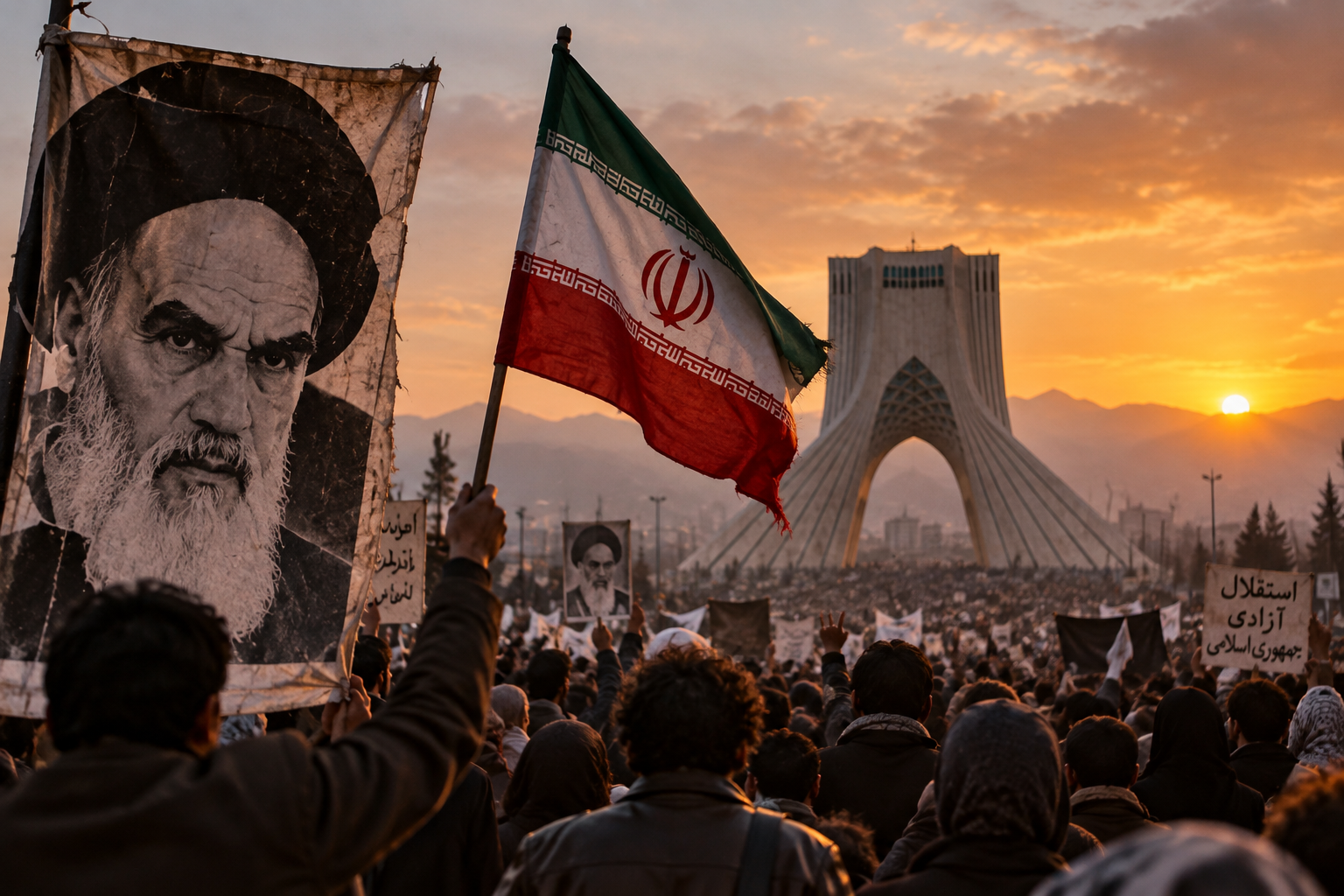
What They Thought They Were Supporting
History usually looks a lot cleaner after the fact than it did while people were actually living through it. Revolutions are especially good at that. Years later, we draw neat little lines between events and act like everyone should have known exactly where things were headed. If history were really that easy, we would probably make a lot fewer mistakes.
The Iranian Revolution of 1979 is a good example.
Ayatollah Ruhollah Khomeini became the face of the movement that overthrew Shah Mohammad Reza Pahlavi. The Shah was authoritarian, and opposition to him came from several directions: religious conservatives, liberals, nationalists, leftists, students and ordinary citizens who simply wanted political change. That coalition mattered because not everyone standing on the same side of the street was headed to the same destination.
Years before the revolution, Khomeini had already laid out a very specific vision of government. In lectures given in Najaf in 1970, later published as Islamic Government, he argued that Islamic jurists should exercise political authority. The doctrine became known as velayat-e faqih, or guardianship of the Islamic jurist. So the idea of clerical rule did not suddenly fall out of the sky after the Shah was gone. It was already there.
But something changed in the way Khomeini spoke publicly as the revolution approached.
During his exile in France in 1978, he emphasized elections, freedom and popular choice. In a November 1978 interview reported by The Washington Post, Khomeini said the Iranian people would choose their government through universal suffrage. He also said he had no intention of heading the government or becoming part of it. Now, I am no constitutional scholar, but that sounds quite a bit different from building a system where the highest political authority belongs to a religious jurist.
And apparently some of Khomeini’s own allies heard the difference too.
Mehdi Bazargan, a respected opposition leader and later the first prime minister after the Shah fell, supported the revolution but did not support supreme clerical government. Encyclopaedia Iranica reports that Bazargan and his Freedom Movement mistakenly believed Khomeini no longer supported velayat-e faqih. They expected him to serve more as a spiritual or general leader than as the ultimate political authority.
That may be one of the most important pieces of this entire story. These were not simply people who supported the revolution and then got cold feet when things became difficult. Some of them appear to have believed they were helping create a government fundamentally different from the one that eventually emerged.
Bazargan’s provisional government prepared an early draft constitution that did not contain the later system of supreme clerical rule. The structure was much closer to a conventional republic, with elected officials holding greater authority and religious oversight far more limited.
Then things changed, and not in a small-print-at-the-bottom-of-the-contract kind of way.
An Assembly of Experts dominated by clerics rewrote the proposed constitution. Encyclopaedia Iranica says the earlier draft was altered “beyond recognition.” The new constitution placed velayat-e faqih at the center of the political system, giving enormous authority to the supreme religious jurist.
At roughly the same time, the political atmosphere was changing too. Opposition newspapers were closed. Liberal and secular groups that had helped overthrow the Shah began losing influence. Bazargan and others became increasingly frustrated that the provisional government had authority on paper but far less control over the revolutionary institutions actually shaping the country. Having a title is one thing. Having the power that supposedly comes with it is another.
By November 1979, Bazargan resigned. The revolution he had helped support was no longer becoming the government he thought he had been helping to build.
Abolhassan Bani-Sadr followed a similar path. He had been close to Khomeini during exile and became the Islamic Republic’s first elected president. Yet he eventually came into conflict with the clerical leadership over the growing power of religious institutions. He was removed from office in 1981 and fled Iran. Once again, people who had helped overthrow the old government ended up opposing the system that replaced it.
That brings us to the uncomfortable question: were they deceived?
History does not give us a single document in which Khomeini writes, “I will tell these people one thing until I have power and then do another.” History almost never makes things that convenient. Without that kind of evidence, it would be irresponsible to claim that his private intentions have been proven.
But the documented record still shows something important. Khomeini had already written about clerical government years before the revolution. During the critical period when he needed broad public support, he emphasized elections, popular sovereignty and a limited personal political role. Some of his major allies apparently believed those statements and expected a government without supreme clerical control. After the revolution succeeded, the political system moved much closer to the model Khomeini had described years earlier.
That does not automatically prove a secret plan, but it does give us a reason to ask whether everyone standing beside him understood what they were helping create.
There is another part of the story that deserves attention. Once Khomeini was in power, political crises repeatedly strengthened the clerical leadership. Contemporary American diplomatic reports observed that conflicts such as the Kurdish uprising allowed Khomeini to rally support, restrict opposition and strengthen his authority. The American hostage crisis later intensified internal political struggles and helped weaken liberal and moderate factions.
That does not mean Khomeini created every crisis. Sometimes history hands political leaders a crisis whether they want one or not. The more revealing question is what they do with it, and Khomeini and his allies proved very effective at turning turmoil into political advantage.
That may be the larger lesson in all of this. Political movements are often judged by what they promise before gaining power, but history judges them by what they do afterward. In Iran, the distance between those two moments was enormous. Many people believed they were helping overthrow an authoritarian monarchy and build a republic influenced by Islam. What emerged was a system in which religious authority stood above elected political institutions, and some of the very people who helped make the revolution possible eventually found themselves pushed aside by it.
There is something painfully human in that. People can become so focused on tearing down what they oppose that they do not always ask enough questions about what is waiting to replace it. In Iran, that question mattered enormously, because by the time some of Khomeini’s early allies fully understood the direction the revolution was taking, the balance of power had already shifted.
Maybe the most important question, then, is not simply whether these leaders supported Khomeini. We already know they did. The better question is whether they truly understood what they were supporting, and whether the government they helped bring into being was the government they believed they were being promised.
References
Encyclopaedia Iranica, “Khomeini II: Works”
https://www.iranicaonline.org/articles/khomeini-ii-works/Encyclopaedia Iranica, “Khomeini I: Life”
https://www.iranicaonline.org/articles/khomeini-i-life/Encyclopaedia Iranica, “Constitution of the Islamic Republic”
https://www.iranicaonline.org/articles/constitution-of-the-islamic-republic/Encyclopaedia Iranica, “Islamic Political Movements in 20th-Century Iran”
https://www.iranicaonline.org/articles/islam-in-iran-xiii-islamic-political-movements-in-20th-century-iran/Encyclopaedia Iranica, “Hostage Crisis”
https://www.iranicaonline.org/articles/hostage-crisis/The Washington Post, November 7, 1978, reporting Khomeini’s comments on universal suffrage and his future political role
https://www.washingtonpost.com/archive/politics/1978/11/07/military-cracks-down-on-rebels-in-iran/75800364-a814-487e-a420-ad9165698a80/U.S. Department of State, Foreign Relations of the United States, 1977–1980, Volume XI, Part 1, Document 37
https://history.state.gov/historicaldocuments/frus1977-80v11p1/d37U.S. Department of State, Foreign Relations of the United States, 1977–1980, Volume XI, Part 1, Document 94
https://history.state.gov/historicaldocuments/frus1977-80v11p1/d94U.S. Department of State, Foreign Relations of the United States, 1977–1980, Volume XI, Part 1, Document 281
https://history.state.gov/historicaldocuments/frus1977-80v11p1/d281By J Jones
-

What Happened to Understanding?
What is friendship? Who really knows anymore? Do friends stab you in the back? They’re not supposed to. Do friends ghost you without explaining why? That’s not what I thought friendship was, but hey, maybe I missed the memo.
In my mind, friends are supposed to be there through the good times and the bad ones. They understand you, or at least try to. They know your weaknesses, your faults and the things that make you difficult sometimes, because none of us are exactly a walk in the park. Real friends don’t have to agree with everything you do, but they should be able to talk to you about it. They shouldn’t bad-mouth you behind your back or quietly disappear when things get uncomfortable. Friendship should mean standing beside someone, even when standing beside them isn’t always easy.
Unfortunately, sometimes it feels like friends today are a dime a dozen because that may be about what some friendships are worth. I used to hold tightly to the people I considered friends. Maybe too tightly. I believed that even though I have plenty of flaws, the people who truly knew me would still be there. Maybe I expected too much. Maybe year after year my flaws became too much for some people to accept.
But should that leave me believing there is simply something wrong with me? I don’t think so. Maybe my former friends could explain it to me—ohhh, wait. That’s part of the problem. Instead of saying, “Here’s what bothers me,” or giving someone a chance to understand what changed, people sometimes just push you away. Then you are left standing there trying to solve a puzzle without knowing half the pieces are missing.
I sometimes tell myself I have learned not to care about people anymore. Then I have to add the obvious question: Have I really? Probably not. If I truly didn’t care, I wouldn’t be writing this. What bothers me isn’t simply losing a friendship or discovering someone doesn’t like me. People come and go. What bothers me is the lack of honesty that so often comes with it. People lie, disappear, talk behind each other’s backs and leave the other person wondering what happened.
Whatever happened to simply knowing where you stood with somebody? I could respect an honest “I don’t like you” far more than a smile to my face followed by something completely different when I walk away. At least honesty gives you something real to work with. You may not like the answer, but you understand it.
That brings me to something I struggle with even more: respect. I was raised to respect people, and I still want to believe everyone deserves a certain level of basic human respect. But sometimes that gets difficult when the respect only seems to travel in one direction. People feel perfectly comfortable judging someone else while believing they themselves should somehow be protected from the same judgment.
I see smaller examples of this all the time. One day at work, a conversation turned to snow in Japan. A coworker insisted that it doesn’t snow there because he had never seen it. I explained that Japan absolutely gets snow—enormous amounts in some places—and that it would take about thirty seconds to verify it.
You would think that would have ended the discussion. Nope. Apparently facts can be inconvenient when somebody has already decided they are right.
Instead of checking, I became the guy who supposedly didn’t know what he was talking about. That doesn’t bother me because I need everyone to think I’m right. What interests me is why admitting we are wrong has become so difficult. Somewhere along the way, being corrected started feeling like an attack instead of an opportunity to learn something.
That may be part of the larger problem. We have become very comfortable judging people while becoming increasingly uncomfortable with being questioned ourselves. We want understanding for our own mistakes, personalities and beliefs, but we don’t always extend that same understanding to the person standing beside us.
This isn’t meant to be a story about me whining because somebody hurt my feelings. I’m trying to understand something much bigger. How did we reach a point where people can be surrounded by others and still feel completely alone? How did we become so quick to dismiss people who are different, difficult or simply imperfect?
Maybe friendship is only one piece of that puzzle. Maybe what I’m really looking for is something much simpler: honesty, compassion and a little understanding.
We don’t have to agree with everybody. We don’t even have to like everybody. But we can speak honestly. We can listen before judging. We can tell someone when something is wrong instead of leaving them to figure it out alone. And we can remember that every person we meet is carrying flaws, fears, experiences and struggles that we probably know nothing about.
Everyone is different. Everyone is imperfect.
And everyone deserves to be treated like a human being.
By J Jones
-

The Big Confused Bang: A Universal State of Confusion
Hello. Today I want to explain the truly unexplainable, so if you get to the end of this article still wondering exactly what was explained, I can say with confidence: absolutely nothing.
I will, however, be sure to leave you with more questions than you had before you started this article. I certainly have more. In trying to understand the different possibilities surrounding the beginning of our universe, I have become more educated on the subject. Unfortunately, becoming more educated has not necessarily made me less confused.
The Big Bang Theory — not the TV show — is our best scientific explanation for how the universe developed from an extremely hot and dense early state. Science can describe an incredible amount of what happened afterward, but what it cannot yet tell us with certainty is what caused it, what existed before it, or whether there actually was a “before.” Religion cannot, if you will forgive me, simply shine God’s light on the answer and settle the matter either.
So we are going to take a little journey through science, religion, time, physics and a few theories that may leave both you and me wondering whether we should have started this conversation in the first place. Let’s begin with nothing, or perhaps more accurately, with the question of whether there was ever really nothing at all.
That sounds simple until you stop and think about what “nothing” would actually mean. We usually picture emptiness, but even emptiness gives us something to work with. An empty room still has space. Darkness still has somewhere to be dark. Even the idea of waiting for something to happen assumes there is time in which it can happen. True nothing would be harder to imagine than that: no space to fill, no clock to tick, no energy waiting around, and no place for anything to suddenly appear.
Then physics comes along and makes the whole idea even more confusing. What science sometimes calls empty space is not necessarily empty in the everyday sense. At the quantum level, there can still be fields, activity and physical rules operating in the background. So when someone says the universe may have come from “nothing,” we have to stop and ask what kind of nothing they mean. If there were already laws, fields or even the possibility for something to happen, then maybe nothing was never really nothing at all.
And there we are. One question in, and the floor is already moving under us.
The Big Bang Theory itself does not say everything simply burst out of absolute emptiness. What it tells us is that if we follow the universe backward, everything becomes hotter, denser and more tightly packed. Eventually we reach a point where the theories we rely on stop giving us a clear picture. That does not mean science failed. It means we reached the edge of what the current tools can explain, and naturally scientists did not leave it there.
One idea is inflation, which suggests the very early universe went through a burst of expansion so fast that even calling it fast does not really do it justice. Inflation helps explain why the universe looks the way it does today and why enormous regions of space seem so similar to one another. That sounds promising until we ask what caused inflation.
Another possibility is that our Big Bang was not the first event in the story. Some models suggest an earlier universe may have collapsed and then rebounded into ours. Other ideas picture the universe going through repeated periods of expansion and contraction. Then there is the multiverse, where our universe could be only one among many. Each idea gives us a possible answer, and each answer immediately hands us another question. If another universe came first, where did that one come from? If universes keep repeating, what started the cycle? If there are countless universes, what is behind the whole system?
At some point, it begins to feel like we have not found the beginning at all. We have just kept moving the sign that says “Beginning” farther down the road.
And then Einstein enters the conversation, because apparently our understanding of the universe was not confusing enough already.
Relativity showed us that time is not one giant universal clock ticking the same way for everyone. Speed matters. Gravity matters. Two people can experience different amounts of time and both can still be right about what their clocks measured. Move fast enough and your time slows compared with someone who stays behind. That sounds like something out of science fiction, but time dilation has been measured and confirmed.
Which means that, in a limited sense, we already know how to travel into the future. If you could travel close enough to the speed of light, you might experience far less time than the people you left behind. Come home and they could have aged much more than you did. Unfortunately, science has been considerably less helpful about getting you back in time for dinner.
Relativity also gives us another strange idea to deal with. There is no single universal “now” that everyone in the universe shares. Space and time are tied together, and some interpretations suggest that what we call the past, present and future may all belong to one larger structure. That does not mean you should start making plans for a weekend trip to 1975, but it does mean that the way we experience time may not be the whole story.
Now take that thought all the way back to the beginning. What if time itself began with the universe? If that is true, asking what happened before the Big Bang could be the wrong question. There may not have been a “before” because there was no time yet for anything to be before anything else. I told you I was going to leave you with more questions.
Now religion gets a seat at the table.
Christianity and Judaism traditionally teach that creation ultimately comes from God. Islam also describes God as the creator of the heavens and Earth. In those traditions, God is not simply another object sitting somewhere before the universe appeared. God is understood as existing independently of creation itself.
Other religions approach the question differently. Hindu traditions include vast cycles of creation, destruction and renewal. Buddhism generally focuses less on finding one absolute first moment and more on causes, conditions and the chain of events that produces what comes next. I am not suggesting any ancient religion secretly wrote modern physics thousands of years early. That would be stretching both religion and science farther than they deserve. What interests me is the fact that people have been asking the same basic question for a very long time: where did all of this come from?
Religion often answers that question with God. Science answers by asking what evidence can be found. Then comes the uncomfortable question: if everything needs a cause, what caused God? The traditional religious answer is that God did not begin and therefore does not need a cause. God is eternal. Fair enough, but then the question can be turned around. If something can exist without ever having been created, why could that not be the universe itself, some deeper quantum reality, or whatever may exist underneath the universe we see?
Religion can send the question right back. Suppose science someday finds some basic field, law or underlying reality that has always existed. Why does that exist? If we eventually reach a point where science says, “That is simply the way reality is,” have we completely escaped the mystery, or have science and religion just reached the same wall from different directions?
There is another part of this that fascinates me. When religion describes God as eternal, we tend to picture something existing for an endless amount of time. But what if time itself belongs to the universe? Something existing independently of the universe might not experience yesterday, today and tomorrow the way we do. It might not exist forever within time. It could exist beyond time as we understand it.
No, Einstein did not prove God exists. I am fairly certain dragging him into that argument would annoy both physicists and theologians. But modern physics has made time strange enough that the phrase “outside of time” no longer sounds quite as simple as it once did.
And while all of us are trying to make sense of this, science keeps looking deeper. We build better telescopes, study older light, map larger portions of the universe and test ideas about dark energy, black holes, quantum physics and cosmic expansion. Each generation seems able to look farther than the one before it, and every time another door opens, there seems to be another one behind it.
Maybe science will eventually discover exactly what led to our Big Bang. If it does, someone will almost certainly ask what came before that. Maybe another universe came first. Maybe there was some kind of quantum beginning. Maybe universes have always existed in one form or another. Maybe our understanding of time is so limited that words like “before,” “beginning” and “cause” do not work the way we think they do. Maybe religion is right that something exists beyond what we can measure. Maybe science will one day uncover something neither science nor religion has imagined yet.
I do not know, and that may be the most important thing I learned while trying to understand all of this. There does not always seem to be one answer. One answer leads to another theory, another theory opens another direction, and another direction produces another question.
It is a little like eating a Lay’s potato chip or grabbing one McDonald’s fry. There is never just one. Perhaps knowledge works the same way. Maybe learning is not a straight road toward one perfect answer. Maybe it is a road that keeps branching the farther we travel.
Science has given us an extraordinary understanding of how the universe developed. Religion has spent thousands of years asking why a universe exists at all. Philosophy keeps asking whether either one has actually reached the bottom of the question. And perhaps reaching the bottom is not even the point. Maybe the real value is in being willing to keep asking.
Maybe the greatest mystery is not exactly what happened at the Big Bang, and maybe it is not what happened before it. Perhaps the question hiding underneath all the others is the simplest one of all: Why is there something instead of nothing?
If you came here expecting me to answer that, you apparently skipped my opening paragraph. I promised to explain absolutely nothing. After all of this, I believe I have succeeded.
But hopefully you are now just as confused as I am — and maybe just a little more curious.
By J Jones
-

Where Love Goes
Where does love begin its way,
does it come at night or light of day?
Does it find us when we’re standing still,
or cross our path against our will?Sometimes love is almost there,
a gentle touch, a moment shared.
And just when both our hearts believe,
it turns around and starts to leave.You cannot hold it in your hand,
or make it stay at your command.
For love will wilt when held too tight,
but given room, it finds its light.So let your heart become its home,
but never cage its need to roam.
Let love be close, yet still be free,
and let it grow beside your dreams.Let it guide you down the road,
but never make you bear its load.
For love should add to who you are,
not dim your light or hide your star.And when it comes, then let it play,
let laughter steal your cares away.
Be foolish sometimes, dance awhile,
for love looks beautiful in a smile.Yet love will not be joy alone,
sometimes its hardest face is shown.
There will be tears and sleepless nights,
and days when wrong outweighs the right.But love is living, love must breathe,
it cannot blossom if we squeeze.
It moves like water through the land,
too wild for any human hand.And if one day it flows away,
don’t dam the creek and make it stay.
For water travels where it must,
and loving sometimes means we trust.Perhaps that love will circle round,
and someday find familiar ground.
Or maybe love will come anew,
with different eyes that look at you.For love may leave, but love’s not gone,
the river of the heart flows on.
And somewhere farther down the stream,
it finds another place to dream.So open wide your heart and see—
love only stays when it is free.
And though the one you loved may go,
love always finds a way to flow.By J Jones
-

Maybe This Time the Dolphins Are Actually Building Something
I haven’t watched a single preseason NFL game this year. Normally that would feel strange for me, but this season feels different. I already know Miami could be in for a long year, and for once I’m not going into September trying to convince myself that a few new pieces have suddenly turned the Dolphins into a Super Bowl contender.
I’ve followed this team for most of my life, long enough to see plenty of promising starts, expensive fixes and new beginnings that never quite became what we hoped they would. Maybe that history is exactly why I’m more interested this year in what Miami is trying to build than I am in what its record looks like in December.
For years, the Dolphins have seemed to chase the finished product before putting enough underneath it to make it last. Bring in the big name. Find the missing piece. Change the coach. Draft another quarterback. None of those moves are necessarily wrong, but great players can only carry a shaky foundation so far.
That is why this rebuild has my attention.
Dolphins coach Jeff Hafley has made it clear that success this season won’t be defined by wins alone. He has talked about development, building the foundation the right way and refusing to take shortcuts.
I know some fans hear that and immediately think excuses are being made before the season even begins.
I heard something else.
I heard honesty.
If this really is a rebuild, then rebuild it. Don’t slap some expensive paint over the cracks and tell us the house is ready.
Miami already has a few players who look like legitimate pieces of that foundation. De’Von Achane is one of the most dangerous players in football when the ball is in his hands, and Jordyn Brooks has shown he can be an important part of this defense. There may be others, and I hope there are, but some players I might have confidently called building blocks a year ago didn’t have the seasons I expected.
Maybe that wasn’t entirely their fault. Coaching matters. Injuries matter. The players around you matter. Football is rarely as simple as looking at one player’s numbers and deciding whether he can or can’t play.
So until some of those questions are answered, I reserve my right to be cautiously optimistic.
Then we get to Malik Willis.
And this one interests me.
My concern with Willis has never been that he doesn’t have talent. The talent is obvious. ESPN pointed out that over the last two seasons, among quarterbacks with at least 100 dropbacks, Willis had the highest explosive-pass rate in the NFL at 17.4% and the highest scramble rate at 13.0%.
Those numbers should get your attention.
They tell us Willis can create something when a play breaks down. He can hurt a defense with his arm, escape with his legs and turn a play that looks dead into the kind of play that reminds you why football is fun to watch.
But there is another side to that argument.
A lot of what we saw from Willis happened in Green Bay, with Matt LaFleur calling plays and a stronger supporting cast around him. That matters. Good coaching and good players can hide weaknesses and make a quarterback’s job a whole lot easier.
Miami may not be able to give him that same cushion.
So I have questions.
Can he do it consistently? Can he make the routine throws along with the spectacular ones? Can he stand in there on third-and-eight when everybody in the stadium knows he has to throw? Can he lead an offense when he is no longer the interesting backup stepping into somebody else’s machine?
I don’t know.
And that’s okay.
The jury is still out, and I’m willing to let the evidence come in before I make up my mind.
I’m not ready to crown Malik Willis as Miami’s next great quarterback, and I’m certainly not ready to run him out of town before he has had a real chance to show us what he can do.
He’s wearing aqua and orange now, so he gets my support.
What I don’t want to see is Dolphins fans treating every Sunday like a final verdict on whether this rebuild has succeeded or failed. I understand the frustration. We’ve all watched this team chase answers before, and patience gets harder every time a new beginning starts to look suspiciously like the last one.
But a real rebuild is not supposed to look pretty from the beginning.
Young players make mistakes. Some players you believe in will disappoint you. Somebody nobody is talking about in September may look like part of the future by December. Coaches will learn who can play, who can’t and who deserves another year.
There will probably be Sundays when I yell at the television and wonder why I ever talked myself into being patient.
That’s part of being a Dolphins fan.
But this year I want to look at something besides the final score.
Does this team look better in January than it did in September? Are the young players developing? Is Malik Willis improving? Are draft picks becoming starters instead of disappearing from the roster? Is the defense finding an identity? When somebody makes a mistake, does he make the same one three weeks later, or does he learn from it?
Those things matter when you are trying to build something that lasts.
So to my fellow Dolphins fans, I’m not asking you to stop caring about wins. I certainly won’t. I’m not asking anybody to give this new regime a free pass either. If the coaching is bad, say it’s bad. If the decisions don’t make sense, question them.
I’m only asking that we give this thing enough breathing room to find out what it actually is.
Watch the young players. Watch them struggle. Watch them learn. Hopefully, watch a few of them turn into players we’ll be talking about years from now.
And watch Malik Willis.
Maybe those flashes of explosive football are showing us what he can become. Maybe Green Bay made him look better than he really is. Maybe the truth is somewhere in between.
We’re finally going to find out.
I can handle a difficult season if I can see where the team is going. What I’m tired of is watching Miami start over without ever seeming to build anything that lasts.
So build it.
Build it right.
And give us something worth believing in again.
By J Jones
-
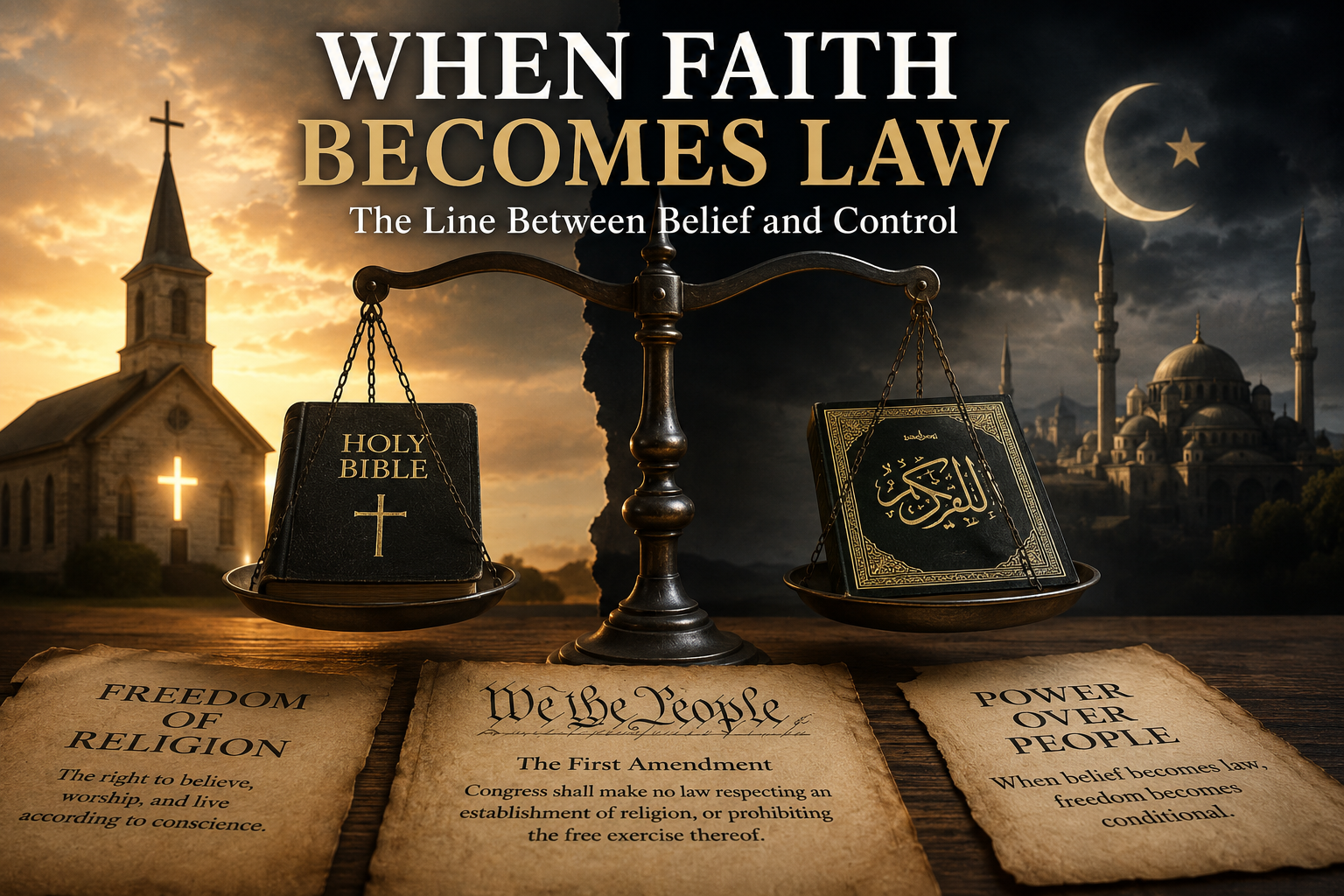
When Faith Becomes Law
I started thinking about this with a pretty firm opinion: I don’t believe Sharia law has a place governing a free society.
Notice I said governing.
A Muslim has every right to practice his faith. The same freedom that allows me to open my Bible, pray to Jesus and call myself a Christian must protect his right to open the Quran, pray and live according to his beliefs. Otherwise, what I am defending isn’t religious freedom. It is simply freedom for my religion.
But that left me with a question I couldn’t ignore.
If I don’t want another man’s religion governing me, how much power should my religion have over him?
That is where this became more complicated than I expected.
Sharia isn’t one giant Islamic law book followed identically everywhere. Its interpretation and legal authority differ considerably from country to country. A Muslim personally choosing to live according to Islamic principles is one thing. A government making its interpretation of those principles compulsory law is something very different.
Iran shows just how different.
Article 4 of Iran’s constitution requires its laws and regulations—including civil, criminal, economic, administrative, military and political laws—to be based on Islamic criteria. Islamic jurists within its governmental structure have authority to determine whether legislation conforms to those requirements.
Think about what that actually means.
As a Christian, would I willingly live under a government where Islamic religious authorities could determine whether the laws governing my life were religiously acceptable?
No.
But fairness requires me to turn the question around.
Would the Muslim living next door want Christian religious authorities deciding whether America’s laws properly followed my Bible?
Probably not.
And I couldn’t blame him.
That doesn’t mean Christianity and Sharia exercise equivalent governmental power today. They don’t. Christianity influences American politics enormously, but the Bible isn’t America’s criminal code and Christian ministers don’t possess constitutional authority to reject federal legislation because it violates Christian doctrine. America’s First Amendment protects religious exercise while restraining government from establishing religion.
That difference becomes much more important when we stop talking about political influence and start talking about human lives.
Life and death.
Look at homosexuality.
I am a Christian. My faith has teachings about sexual morality, and I am entitled to believe them. A Muslim is entitled to his beliefs as well.
But my freedom to believe something is sinful is very different from my government having the authority to punish someone because my religion says it is sinful.
Saudi Arabia criminalizes consensual same-sex sexual activity under its Sharia-based criminal system, with punishments that can include the death penalty. Under Taliban rule in Afghanistan, LGBT people face severe persecution, and same-sex sexual activity can potentially be punished by death under the interpretation of Sharia applied there.
Whether you believe homosexuality is right, wrong or somewhere in between, stop and consider what we are actually discussing.
A human being can potentially lose his life because a government controlled by religious doctrine has turned a matter of faith into a matter of criminal law.
That isn’t merely someone’s freedom to believe anymore. That is the power of the state.
Christians shouldn’t get too comfortable pointing across the ocean, either.
Uganda’s Anti-Homosexuality Act includes the death penalty for an offense classified as “aggravated homosexuality.” Its Constitutional Court upheld most of the law in 2024, including the availability of the death penalty in certain circumstances. Religious leaders have been among those contributing to the country’s hostile political environment toward LGBT people.
Uganda isn’t Iran. Christian religious authorities do not possess the sweeping constitutional authority Islamic jurists possess within Iran.
But if religious belief contributes to government having the power to imprison or execute another human being, Christians should be willing to examine our own influence just as critically as we examine Islam.
I cannot condemn religious coercion when Muslims practice it and conveniently look away when Christians contribute to it.
Then there is Israel, which refuses to fit neatly into either box.
Israel defines itself as the nation-state of the Jewish people while maintaining democratic institutions. Religion nevertheless possesses real governmental authority in certain areas. Its legal system includes Rabbinical, Sharia, Druze and Christian religious courts, including jurisdiction involving important personal-status matters.
That helped me realize that religion and government aren’t simply two switches marked ON and OFF.
There is a line, and different governments stand at different places along it.
Israel also forced me to examine something else I had heard: that Sharia calls for the death of Jews.
I couldn’t substantiate that as a blanket description of Sharia.
In fact, Iran’s Islamic constitution expressly recognizes Jews, Christians and Zoroastrians as religious minorities, although recognized and unrecognized religious minorities can still face significant restrictions and discrimination there.
But that doesn’t make the darker part of this subject disappear.
Hamas’s original 1988 charter contained explicitly antisemitic religious language, including a passage about Muslims fighting and killing Jews. Its later political document changed that framing and presented its conflict as being with Zionism rather than Jews simply because they are Jewish, while Hamas continued to reject Israel’s legitimacy.
Iran’s government has likewise maintained fierce opposition to Israel in its present form.
It would still be wrong, however, to turn that into “Muslims want Israel destroyed.”
The 2025 New York Declaration supports a sovereign Palestinian state living beside Israel in peace and security and says Hamas must end its rule in Gaza and hand its weapons to the Palestinian Authority. The Organization of Islamic Cooperation likewise reaffirmed in 2025 that a two-state solution is the only viable solution for regional peace and stability.
That distinction matters.
Iran is not Islam. Hamas is not Islam. Hamas is not every Palestinian. And the actions of a Christian extremist don’t represent every Christian.
The more important question is what happens when any religious movement becomes powerful enough to turn its beliefs into compulsory law for everyone else.
Pakistan gives us another example. Its constitution provides for a Federal Shariat Court that can examine whether laws are incompatible with the injunctions of Islam. Pakistan’s blasphemy laws can also result in death sentences. Whether or not those sentences ultimately result in execution, the fact that a person can face death under law for a religious offense should make anyone who values freedom stop and think.
This is where my original concern about Sharia remains.
There is a profound difference between allowing a Muslim to practice Sharia voluntarily and allowing religious authorities to make Sharia compulsory for people who do not believe in it.
One is religious freedom.
The other can become religious control.
And Christianity deserves exactly the same warning.
If Christians tomorrow demanded governmental authority to punish people simply for violating biblical teachings, I would have the same problem with it.
Because if I demand freedom to follow Christ while denying another person the freedom not to, I haven’t really defended religious freedom at all.
I have defended myself.
I started this article with a bias, and I might as well admit it.
I believed Sharia law had no place governing a free society. I had seen what can happen when religious authority becomes government authority, and much of what I saw disturbed me.
After researching it, that opinion has not changed.
It has broadened.
I no longer believe the warning should be directed only toward Sharia. I believe no religion—Islam, Christianity, Judaism or any other—should control government, write its religious beliefs into criminal law, or determine punishment simply because someone has violated its teachings.
That realization forced me to look at my own Christianity by the same standard I was applying to Islam. If I would reject living under another man’s religious law, I cannot honestly demand that he live under mine.
And perhaps the greatest danger comes when the most extreme voices gain enough power to stop persuading people and start controlling them.
Extremism does not become less dangerous because I happen to recognize the holy book being carried beside it.
I am still a Christian. My faith still guides the way I live and the decisions I make. I want elected leaders with moral conviction, and I don’t expect them to leave their faith at the door when they enter government.
But there is a difference between faith guiding a leader and faith controlling the law.
The moment faith needs a prison to keep someone from leaving, an executioner to punish someone for loving differently, or a government to silence the person who questions it, something has changed.
That is no longer simply faith.
It is power wearing the robes of faith.
And perhaps that is the line the free world can never afford to cross.
We protect religious freedom by electing leaders who understand something that extremists of every faith too often forget:
Faith may guide government, but it must never control it.
by J Jones
References
Constitution of the Islamic Republic of Iran — Articles 4, 13 and 14, including Islamic review of legislation. Constitute Project.
Constitution of Pakistan — Provisions establishing the Federal Shariat Court and review of laws for conformity with the injunctions of Islam. Government of Pakistan.
First Amendment Religion Clauses — Constitution Annotated, U.S. Congress.
Saudi Arabia: Criminalization of Same-Sex Activity — Human Dignity Trust. Current country profile covering Saudi Arabia’s Sharia-based criminal system and applicable penalties.
Afghanistan: Criminalization of Same-Sex Activity — Human Dignity Trust. Current country profile covering Taliban rule, LGBT persecution and penalties under its interpretation of Sharia.
Uganda Anti-Homosexuality Act — Human Rights Watch. Reporting on the 2023 law, its constitutional challenge and the death penalty for “aggravated homosexuality.”
Israel: Religious Courts and Personal-Status Law — Government of Israel. Official information concerning Rabbinical, Sharia, Druze and Christian religious courts.
Hamas: 1988 Charter and Later Political Positions — Wilson Center. Analysis of the organization’s original charter and later political document.
Pakistan’s Blasphemy Laws and Religious Freedom — U.S. Commission on International Religious Freedom.
-

What If the Whole World Were Looking
Somewhere tonight, a family is waiting for a phone call that may never come. A mother stares at her phone, hoping it will ring. A father replays his last conversation with his daughter, wondering whether he missed something that could have changed what happened. A younger brother asks when his sister is coming home, and no one knows how to answer him. Every birthday passes with an empty chair, every holiday carries a little less joy, and every unexpected knock at the door brings a moment of hope before silence settles over the house again.
Human trafficking does not steal only one person. It steals peace from everyone who loves them.
According to the International Labour Organization, Walk Free, and the International Organization for Migration, nearly 50 million people were estimated to be living in modern slavery in 2021. About 27.6 million were trapped in forced labor, while another 22 million were living in forced marriages. Forced labor in the private economy generates an estimated $236 billion in illegal profits every year, revealing the enormous financial incentive behind human exploitation.
Yet the international community cannot reliably tell us how many trafficking victims are actually rescued each year. Countries use different definitions and reporting systems, and being detected, identified, safeguarded, or removed from immediate danger does not always mean someone has reached lasting freedom. That missing information should trouble us almost as much as the numbers themselves. How can humanity measure whether it is winning this fight when it cannot accurately measure how many people have been brought to safety?
The world has not ignored this crime. The United Nations has a Global Plan of Action, international organizations have held high-level meetings, and law enforcement agencies have shown what international cooperation can accomplish. During INTERPOL’s two-week Operation Liberterra III in late 2025, more than 14,000 officers working across 119 countries safeguarded 4,414 potential trafficking victims and arrested 3,744 suspects. That achievement deserves recognition, but it also raises a larger question: What could that level of cooperation accomplish if it continued every day instead of during individual operations?
If 50 million people were trapped beneath the rubble after an earthquake, nations would mobilize almost overnight. If a disease threatened that many lives, governments, scientists, businesses, and charitable organizations would pour their resources into finding a cure. When nearly 50 million people are estimated to be living without freedom, scattered programs and occasional operations cannot be the end of our response.
The world needs a permanent international effort built around one unmistakable goal: not simply managing human trafficking, but ending it. It should unite governments, law enforcement and intelligence agencies, survivor-led and anti-trafficking organizations, and experts from every field capable of contributing to the solution. Titles should matter less than knowledge. Every participant should arrive prepared to answer one question: What can you contribute that no one else in the room can?
The answer might be a new investigative method, a financial strategy that follows criminal profits, technology that detects hidden networks, a safer way to identify victims, or knowledge from a survivor that no official report could ever teach. It must also include long-term protection, because removing someone from immediate danger is only the beginning. Survivors may need secure housing, medical care, counseling, education, legal protection, employment, and help rebuilding a life that traffickers tried to destroy.
Any serious strategy must also confront corruption. International authorities have documented how bribery and official complicity can help traffickers obtain documents, cross borders, avoid inspections, receive warnings about investigations, or operate without consequences. That does not mean every failed investigation proves corruption, and accusation should never replace evidence. It does mean that a permanent coalition must be independent enough to follow the truth wherever it leads. A trafficking network cannot be dismantled while the people protecting it remain untouched.
Governments alone cannot win this fight because trafficking often hides in ordinary places. It can appear in hotels, truck stops, schools, hospitals, farms, factories, construction sites, private homes, online advertisements, or businesses that seem completely legitimate. A teacher, nurse, truck driver, hotel worker, cashier, neighbor, or friend who recognizes something unusual and reports it may become the reason a victim is found and brought to safety—or, perhaps even more importantly, the reason someone never becomes a victim at all. Public awareness is not an afterthought. A world that understands the warning signs gives traffickers fewer places to hide and fewer lives to steal.
The true measure of success will not be the number of meetings held or declarations signed. It will be networks dismantled, corrupt protectors exposed, survivors given the chance to rebuild, vulnerable people protected before they are taken, and families spared the agony of wondering where someone they love has gone.
Until every trafficker is stopped, none of us is completely free from the fear that the next victim could be someone we love. This fight belongs to every nation, every community, and every person willing to refuse indifference.
The day no family has to wait beside a silent phone, hoping against hope that the next ring will bring their loved one home, will be the day humanity can finally say it refused to look away.
By J Jones