
Tag: Iran

  • What They Thought They Were Supporting

    What They Thought They Were Supporting

    History usually looks a lot cleaner after the fact than it did while people were actually living through it. Revolutions are especially good at that. Years later, we draw neat little lines between events and act like everyone should have known exactly where things were headed. If history were really that easy, we would probably make a lot fewer mistakes.

    The Iranian Revolution of 1979 is a good example.

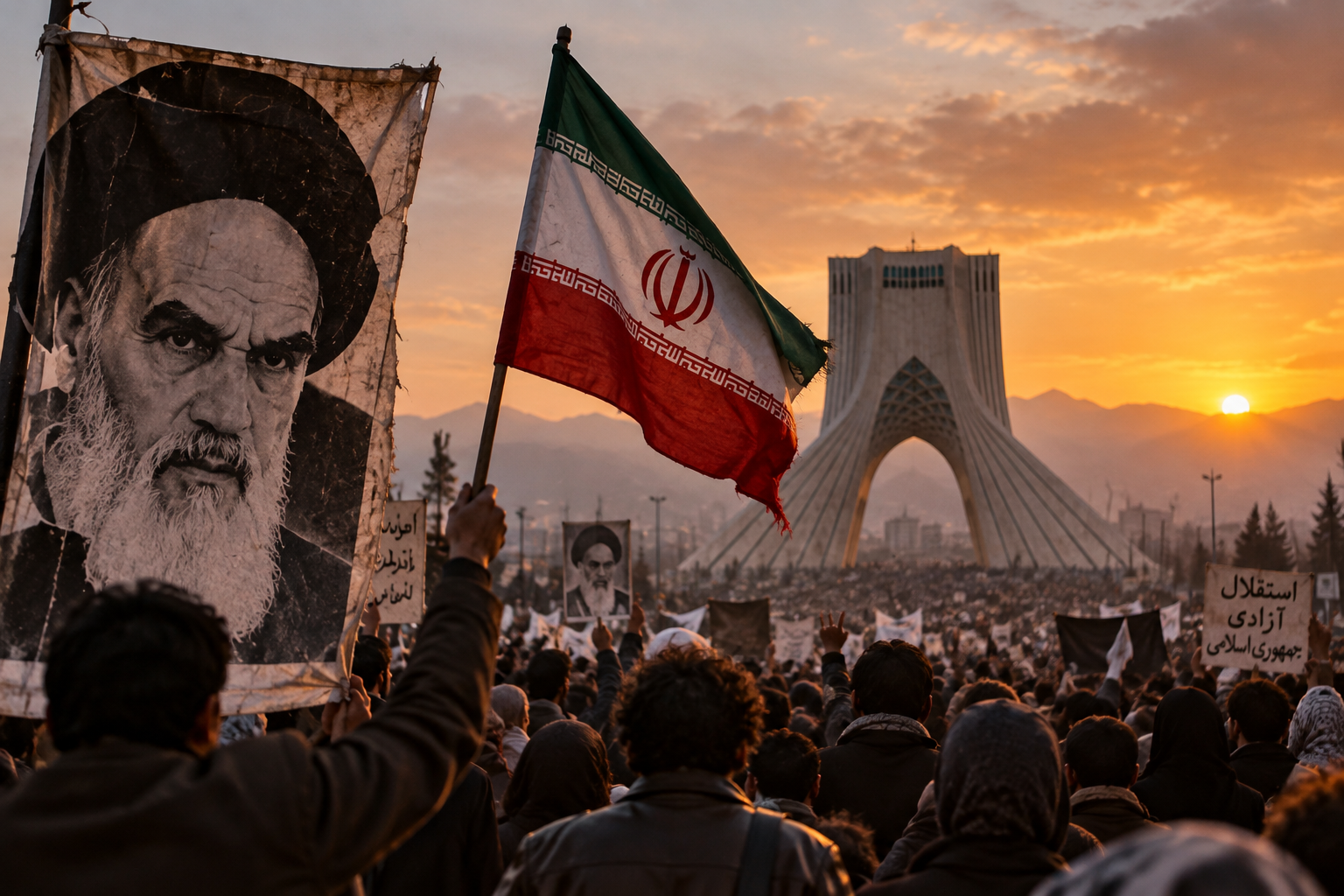
    Ayatollah Ruhollah Khomeini became the face of the movement that overthrew Shah Mohammad Reza Pahlavi. The Shah was authoritarian, and opposition to him came from several directions: religious conservatives, liberals, nationalists, leftists, students and ordinary citizens who simply wanted political change. That coalition mattered because not everyone standing on the same side of the street was headed to the same destination.

    Years before the revolution, Khomeini had already laid out a very specific vision of government. In lectures given in Najaf in 1970, later published as Islamic Government, he argued that Islamic jurists should exercise political authority. The doctrine became known as velayat-e faqih, or guardianship of the Islamic jurist. So the idea of clerical rule did not suddenly fall out of the sky after the Shah was gone. It was already there.

    But something changed in the way Khomeini spoke publicly as the revolution approached.

    During his exile in France in 1978, he emphasized elections, freedom and popular choice. In a November 1978 interview reported by The Washington Post, Khomeini said the Iranian people would choose their government through universal suffrage. He also said he had no intention of heading the government or becoming part of it. Now, I am no constitutional scholar, but that sounds quite a bit different from building a system where the highest political authority belongs to a religious jurist.

    And apparently some of Khomeini’s own allies heard the difference too.

    Mehdi Bazargan, a respected opposition leader and later the first prime minister after the Shah fell, supported the revolution but did not support supreme clerical government. Encyclopaedia Iranica reports that Bazargan and his Freedom Movement mistakenly believed Khomeini no longer supported velayat-e faqih. They expected him to serve more as a spiritual or general leader than as the ultimate political authority.

    That may be one of the most important pieces of this entire story. These were not simply people who supported the revolution and then got cold feet when things became difficult. Some of them appear to have believed they were helping create a government fundamentally different from the one that eventually emerged.

    Bazargan’s provisional government prepared an early draft constitution that did not contain the later system of supreme clerical rule. The structure was much closer to a conventional republic, with elected officials holding greater authority and religious oversight far more limited.

    Then things changed, and not in a small-print-at-the-bottom-of-the-contract kind of way.

    An Assembly of Experts dominated by clerics rewrote the proposed constitution. Encyclopaedia Iranica says the earlier draft was altered “beyond recognition.” The new constitution placed velayat-e faqih at the center of the political system, giving enormous authority to the supreme religious jurist.

    At roughly the same time, the political atmosphere was changing too. Opposition newspapers were closed. Liberal and secular groups that had helped overthrow the Shah began losing influence. Bazargan and others became increasingly frustrated that the provisional government had authority on paper but far less control over the revolutionary institutions actually shaping the country. Having a title is one thing. Having the power that supposedly comes with it is another.

    By November 1979, Bazargan resigned. The revolution he had helped support was no longer becoming the government he thought he had been helping to build.

    Abolhassan Bani-Sadr followed a similar path. He had been close to Khomeini during exile and became the Islamic Republic’s first elected president. Yet he eventually came into conflict with the clerical leadership over the growing power of religious institutions. He was removed from office in 1981 and fled Iran. Once again, people who had helped overthrow the old government ended up opposing the system that replaced it.

    That brings us to the uncomfortable question: were they deceived?

    History does not give us a single document in which Khomeini writes, “I will tell these people one thing until I have power and then do another.” History almost never makes things that convenient. Without that kind of evidence, it would be irresponsible to claim that his private intentions have been proven.

    But the documented record still shows something important. Khomeini had already written about clerical government years before the revolution. During the critical period when he needed broad public support, he emphasized elections, popular sovereignty and a limited personal political role. Some of his major allies apparently believed those statements and expected a government without supreme clerical control. After the revolution succeeded, the political system moved much closer to the model Khomeini had described years earlier.

    That does not automatically prove a secret plan, but it does give us a reason to ask whether everyone standing beside him understood what they were helping create.

    There is another part of the story that deserves attention. Once Khomeini was in power, political crises repeatedly strengthened the clerical leadership. Contemporary American diplomatic reports observed that conflicts such as the Kurdish uprising allowed Khomeini to rally support, restrict opposition and strengthen his authority. The American hostage crisis later intensified internal political struggles and helped weaken liberal and moderate factions.

    That does not mean Khomeini created every crisis. Sometimes history hands political leaders a crisis whether they want one or not. The more revealing question is what they do with it, and Khomeini and his allies proved very effective at turning turmoil into political advantage.

    That may be the larger lesson in all of this. Political movements are often judged by what they promise before gaining power, but history judges them by what they do afterward. In Iran, the distance between those two moments was enormous. Many people believed they were helping overthrow an authoritarian monarchy and build a republic influenced by Islam. What emerged was a system in which religious authority stood above elected political institutions, and some of the very people who helped make the revolution possible eventually found themselves pushed aside by it.

    There is something painfully human in that. People can become so focused on tearing down what they oppose that they do not always ask enough questions about what is waiting to replace it. In Iran, that question mattered enormously, because by the time some of Khomeini’s early allies fully understood the direction the revolution was taking, the balance of power had already shifted.

    Maybe the most important question, then, is not simply whether these leaders supported Khomeini. We already know they did. The better question is whether they truly understood what they were supporting, and whether the government they helped bring into being was the government they believed they were being promised.

    References

    Encyclopaedia Iranica, “Khomeini II: Works”
    https://www.iranicaonline.org/articles/khomeini-ii-works/

    Encyclopaedia Iranica, “Khomeini I: Life”
    https://www.iranicaonline.org/articles/khomeini-i-life/

    Encyclopaedia Iranica, “Constitution of the Islamic Republic”
    https://www.iranicaonline.org/articles/constitution-of-the-islamic-republic/

    Encyclopaedia Iranica, “Islamic Political Movements in 20th-Century Iran”
    https://www.iranicaonline.org/articles/islam-in-iran-xiii-islamic-political-movements-in-20th-century-iran/

    Encyclopaedia Iranica, “Hostage Crisis”
    https://www.iranicaonline.org/articles/hostage-crisis/

    The Washington Post, November 7, 1978, reporting Khomeini’s comments on universal suffrage and his future political role
    https://www.washingtonpost.com/archive/politics/1978/11/07/military-cracks-down-on-rebels-in-iran/75800364-a814-487e-a420-ad9165698a80/

    U.S. Department of State, Foreign Relations of the United States, 1977–1980, Volume XI, Part 1, Document 37
    https://history.state.gov/historicaldocuments/frus1977-80v11p1/d37

    U.S. Department of State, Foreign Relations of the United States, 1977–1980, Volume XI, Part 1, Document 94
    https://history.state.gov/historicaldocuments/frus1977-80v11p1/d94

    U.S. Department of State, Foreign Relations of the United States, 1977–1980, Volume XI, Part 1, Document 281
    https://history.state.gov/historicaldocuments/frus1977-80v11p1/d281

    By J Jones
  • When Faith Becomes Law

    When Faith Becomes Law

    I started thinking about this with a pretty firm opinion: I don’t believe Sharia law has a place governing a free society.

    Notice I said governing.

    A Muslim has every right to practice his faith. The same freedom that allows me to open my Bible, pray to Jesus and call myself a Christian must protect his right to open the Quran, pray and live according to his beliefs. Otherwise, what I am defending isn’t religious freedom. It is simply freedom for my religion.

    But that left me with a question I couldn’t ignore.

    If I don’t want another man’s religion governing me, how much power should my religion have over him?

    That is where this became more complicated than I expected.

    Sharia isn’t one giant Islamic law book followed identically everywhere. Its interpretation and legal authority differ considerably from country to country. A Muslim personally choosing to live according to Islamic principles is one thing. A government making its interpretation of those principles compulsory law is something very different.

    Iran shows just how different.

    Article 4 of Iran’s constitution requires its laws and regulations—including civil, criminal, economic, administrative, military and political laws—to be based on Islamic criteria. Islamic jurists within its governmental structure have authority to determine whether legislation conforms to those requirements.

    Think about what that actually means.

    As a Christian, would I willingly live under a government where Islamic religious authorities could determine whether the laws governing my life were religiously acceptable?

    No.

    But fairness requires me to turn the question around.

    Would the Muslim living next door want Christian religious authorities deciding whether America’s laws properly followed my Bible?

    Probably not.

    And I couldn’t blame him.

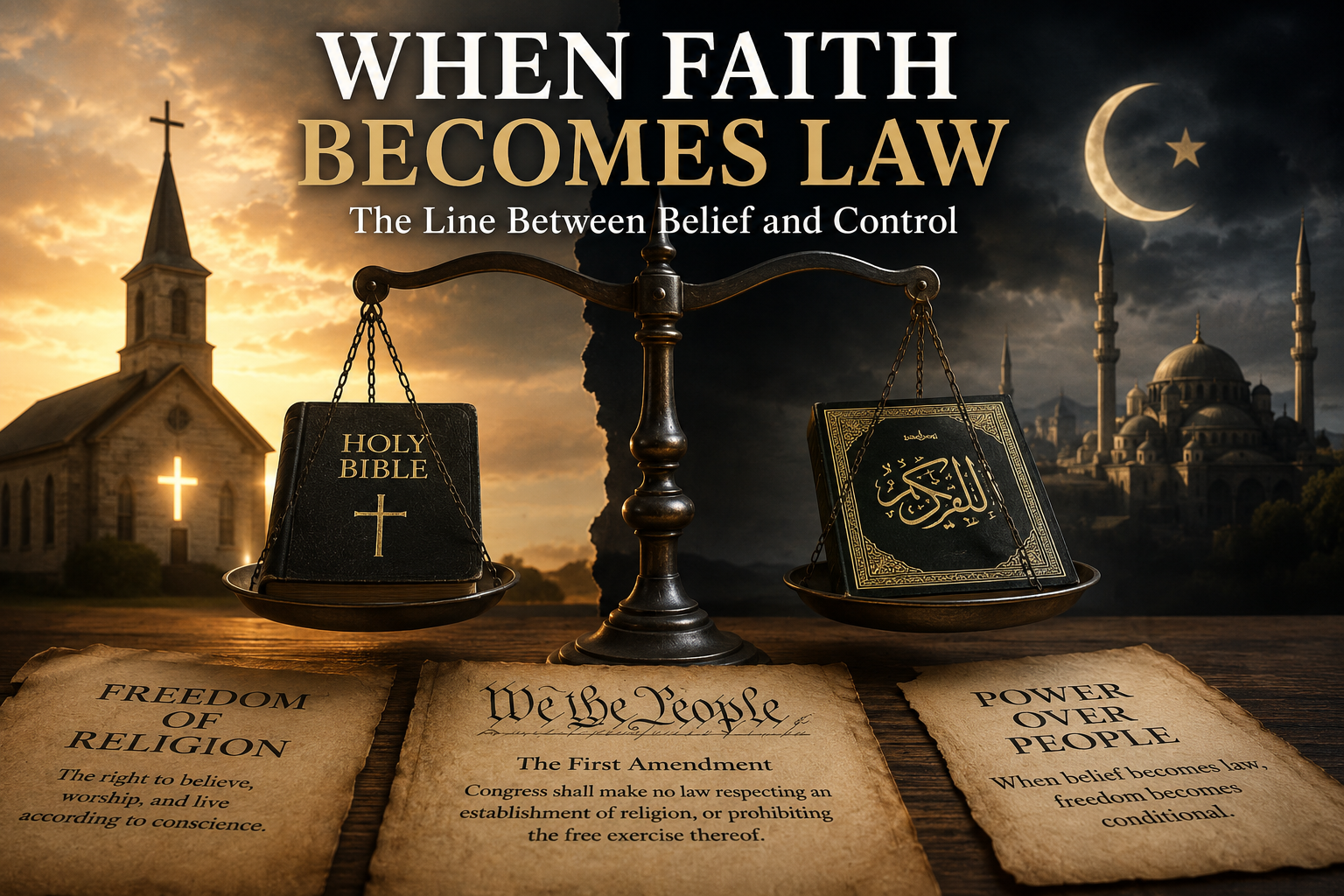
    That doesn’t mean Christianity and Sharia exercise equivalent governmental power today. They don’t. Christianity influences American politics enormously, but the Bible isn’t America’s criminal code and Christian ministers don’t possess constitutional authority to reject federal legislation because it violates Christian doctrine. America’s First Amendment protects religious exercise while restraining government from establishing religion.

    That difference becomes much more important when we stop talking about political influence and start talking about human lives.

    Life and death.

    Look at homosexuality.

    I am a Christian. My faith has teachings about sexual morality, and I am entitled to believe them. A Muslim is entitled to his beliefs as well.

    But my freedom to believe something is sinful is very different from my government having the authority to punish someone because my religion says it is sinful.

    Saudi Arabia criminalizes consensual same-sex sexual activity under its Sharia-based criminal system, with punishments that can include the death penalty. Under Taliban rule in Afghanistan, LGBT people face severe persecution, and same-sex sexual activity can potentially be punished by death under the interpretation of Sharia applied there.

    Whether you believe homosexuality is right, wrong or somewhere in between, stop and consider what we are actually discussing.

    A human being can potentially lose his life because a government controlled by religious doctrine has turned a matter of faith into a matter of criminal law.

    That isn’t merely someone’s freedom to believe anymore. That is the power of the state.

    Christians shouldn’t get too comfortable pointing across the ocean, either.

    Uganda’s Anti-Homosexuality Act includes the death penalty for an offense classified as “aggravated homosexuality.” Its Constitutional Court upheld most of the law in 2024, including the availability of the death penalty in certain circumstances. Religious leaders have been among those contributing to the country’s hostile political environment toward LGBT people.

    Uganda isn’t Iran. Christian religious authorities do not possess the sweeping constitutional authority Islamic jurists possess within Iran.

    But if religious belief contributes to government having the power to imprison or execute another human being, Christians should be willing to examine our own influence just as critically as we examine Islam.

    I cannot condemn religious coercion when Muslims practice it and conveniently look away when Christians contribute to it.

    Then there is Israel, which refuses to fit neatly into either box.

    Israel defines itself as the nation-state of the Jewish people while maintaining democratic institutions. Religion nevertheless possesses real governmental authority in certain areas. Its legal system includes Rabbinical, Sharia, Druze and Christian religious courts, including jurisdiction involving important personal-status matters.

    That helped me realize that religion and government aren’t simply two switches marked ON and OFF.

    There is a line, and different governments stand at different places along it.

    Israel also forced me to examine something else I had heard: that Sharia calls for the death of Jews.

    I couldn’t substantiate that as a blanket description of Sharia.

    In fact, Iran’s Islamic constitution expressly recognizes Jews, Christians and Zoroastrians as religious minorities, although recognized and unrecognized religious minorities can still face significant restrictions and discrimination there.

    But that doesn’t make the darker part of this subject disappear.

    Hamas’s original 1988 charter contained explicitly antisemitic religious language, including a passage about Muslims fighting and killing Jews. Its later political document changed that framing and presented its conflict as being with Zionism rather than Jews simply because they are Jewish, while Hamas continued to reject Israel’s legitimacy.

    Iran’s government has likewise maintained fierce opposition to Israel in its present form.

    It would still be wrong, however, to turn that into “Muslims want Israel destroyed.”

    The 2025 New York Declaration supports a sovereign Palestinian state living beside Israel in peace and security and says Hamas must end its rule in Gaza and hand its weapons to the Palestinian Authority. The Organization of Islamic Cooperation likewise reaffirmed in 2025 that a two-state solution is the only viable solution for regional peace and stability.

    That distinction matters.

    Iran is not Islam. Hamas is not Islam. Hamas is not every Palestinian. And the actions of a Christian extremist don’t represent every Christian.

    The more important question is what happens when any religious movement becomes powerful enough to turn its beliefs into compulsory law for everyone else.

    Pakistan gives us another example. Its constitution provides for a Federal Shariat Court that can examine whether laws are incompatible with the injunctions of Islam. Pakistan’s blasphemy laws can also result in death sentences. Whether or not those sentences ultimately result in execution, the fact that a person can face death under law for a religious offense should make anyone who values freedom stop and think.

    This is where my original concern about Sharia remains.

    There is a profound difference between allowing a Muslim to practice Sharia voluntarily and allowing religious authorities to make Sharia compulsory for people who do not believe in it.

    One is religious freedom.

    The other can become religious control.

    And Christianity deserves exactly the same warning.

    If Christians tomorrow demanded governmental authority to punish people simply for violating biblical teachings, I would have the same problem with it.

    Because if I demand freedom to follow Christ while denying another person the freedom not to, I haven’t really defended religious freedom at all.

    I have defended myself.

    I started this article with a bias, and I might as well admit it.

    I believed Sharia law had no place governing a free society. I had seen what can happen when religious authority becomes government authority, and much of what I saw disturbed me.

    After researching it, that opinion has not changed.

    It has broadened.

    I no longer believe the warning should be directed only toward Sharia. I believe no religion—Islam, Christianity, Judaism or any other—should control government, write its religious beliefs into criminal law, or determine punishment simply because someone has violated its teachings.

    That realization forced me to look at my own Christianity by the same standard I was applying to Islam. If I would reject living under another man’s religious law, I cannot honestly demand that he live under mine.

    And perhaps the greatest danger comes when the most extreme voices gain enough power to stop persuading people and start controlling them.

    Extremism does not become less dangerous because I happen to recognize the holy book being carried beside it.

    I am still a Christian. My faith still guides the way I live and the decisions I make. I want elected leaders with moral conviction, and I don’t expect them to leave their faith at the door when they enter government.

    But there is a difference between faith guiding a leader and faith controlling the law.

    The moment faith needs a prison to keep someone from leaving, an executioner to punish someone for loving differently, or a government to silence the person who questions it, something has changed.

    That is no longer simply faith.

    It is power wearing the robes of faith.

    And perhaps that is the line the free world can never afford to cross.

    We protect religious freedom by electing leaders who understand something that extremists of every faith too often forget:

    Faith may guide government, but it must never control it.

    by J Jones


    References

    Constitution of the Islamic Republic of Iran — Articles 4, 13 and 14, including Islamic review of legislation. Constitute Project.

    Constitution of Pakistan — Provisions establishing the Federal Shariat Court and review of laws for conformity with the injunctions of Islam. Government of Pakistan.

    First Amendment Religion Clauses — Constitution Annotated, U.S. Congress.

    Saudi Arabia: Criminalization of Same-Sex Activity — Human Dignity Trust. Current country profile covering Saudi Arabia’s Sharia-based criminal system and applicable penalties.

    Afghanistan: Criminalization of Same-Sex Activity — Human Dignity Trust. Current country profile covering Taliban rule, LGBT persecution and penalties under its interpretation of Sharia.

    Uganda Anti-Homosexuality Act — Human Rights Watch. Reporting on the 2023 law, its constitutional challenge and the death penalty for “aggravated homosexuality.”

    Israel: Religious Courts and Personal-Status Law — Government of Israel. Official information concerning Rabbinical, Sharia, Druze and Christian religious courts.

    Hamas: 1988 Charter and Later Political Positions — Wilson Center. Analysis of the organization’s original charter and later political document.

    New York Declaration on the Peaceful Settlement of the Question of Palestine and Implementation of the Two-State Solution — United Nations, 2025.

    Istanbul Declaration — Organization of Islamic Cooperation, 2025. Reaffirmation of support for a two-state solution.

    Pakistan’s Blasphemy Laws and Religious Freedom — U.S. Commission on International Religious Freedom.