
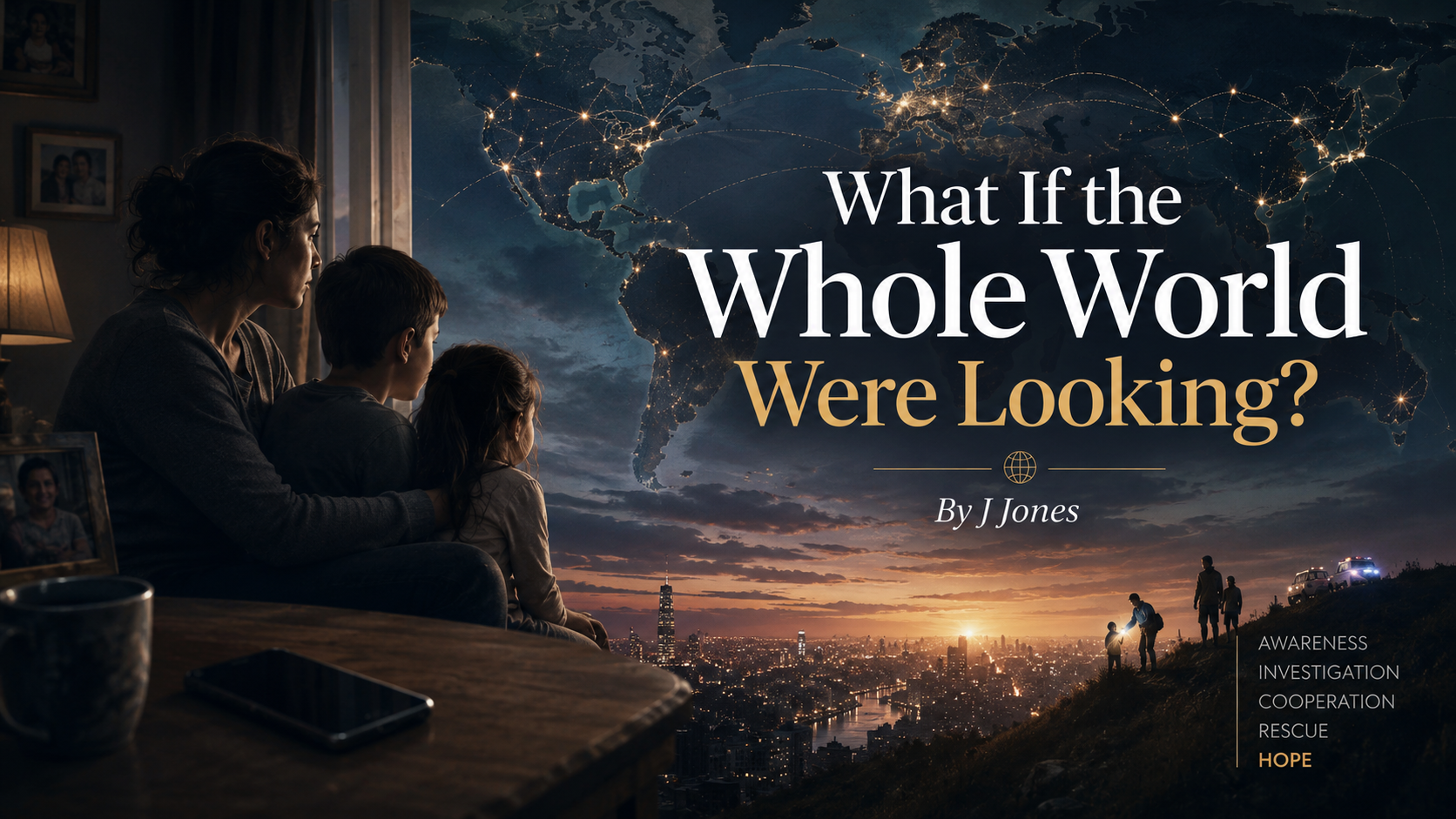
Somewhere tonight, a family is waiting for a phone call that may never come. A mother stares at her phone, hoping it will ring. A father replays his last conversation with his daughter, wondering whether he missed something that could have changed what happened. A younger brother asks when his sister is coming home, and no one knows how to answer him. Every birthday passes with an empty chair, every holiday carries a little less joy, and every unexpected knock at the door brings a moment of hope before silence settles over the house again.
Human trafficking does not steal only one person. It steals peace from everyone who loves them.
According to the International Labour Organization, Walk Free, and the International Organization for Migration, nearly 50 million people were estimated to be living in modern slavery in 2021. About 27.6 million were trapped in forced labor, while another 22 million were living in forced marriages. Forced labor in the private economy generates an estimated $236 billion in illegal profits every year, revealing the enormous financial incentive behind human exploitation.
Yet the international community cannot reliably tell us how many trafficking victims are actually rescued each year. Countries use different definitions and reporting systems, and being detected, identified, safeguarded, or removed from immediate danger does not always mean someone has reached lasting freedom. That missing information should trouble us almost as much as the numbers themselves. How can humanity measure whether it is winning this fight when it cannot accurately measure how many people have been brought to safety?
The world has not ignored this crime. The United Nations has a Global Plan of Action, international organizations have held high-level meetings, and law enforcement agencies have shown what international cooperation can accomplish. During INTERPOL’s two-week Operation Liberterra III in late 2025, more than 14,000 officers working across 119 countries safeguarded 4,414 potential trafficking victims and arrested 3,744 suspects. That achievement deserves recognition, but it also raises a larger question: What could that level of cooperation accomplish if it continued every day instead of during individual operations?
If 50 million people were trapped beneath the rubble after an earthquake, nations would mobilize almost overnight. If a disease threatened that many lives, governments, scientists, businesses, and charitable organizations would pour their resources into finding a cure. When nearly 50 million people are estimated to be living without freedom, scattered programs and occasional operations cannot be the end of our response.
The world needs a permanent international effort built around one unmistakable goal: not simply managing human trafficking, but ending it. It should unite governments, law enforcement and intelligence agencies, survivor-led and anti-trafficking organizations, and experts from every field capable of contributing to the solution. Titles should matter less than knowledge. Every participant should arrive prepared to answer one question: What can you contribute that no one else in the room can?
The answer might be a new investigative method, a financial strategy that follows criminal profits, technology that detects hidden networks, a safer way to identify victims, or knowledge from a survivor that no official report could ever teach. It must also include long-term protection, because removing someone from immediate danger is only the beginning. Survivors may need secure housing, medical care, counseling, education, legal protection, employment, and help rebuilding a life that traffickers tried to destroy.
Any serious strategy must also confront corruption. International authorities have documented how bribery and official complicity can help traffickers obtain documents, cross borders, avoid inspections, receive warnings about investigations, or operate without consequences. That does not mean every failed investigation proves corruption, and accusation should never replace evidence. It does mean that a permanent coalition must be independent enough to follow the truth wherever it leads. A trafficking network cannot be dismantled while the people protecting it remain untouched.
Governments alone cannot win this fight because trafficking often hides in ordinary places. It can appear in hotels, truck stops, schools, hospitals, farms, factories, construction sites, private homes, online advertisements, or businesses that seem completely legitimate. A teacher, nurse, truck driver, hotel worker, cashier, neighbor, or friend who recognizes something unusual and reports it may become the reason a victim is found and brought to safety—or, perhaps even more importantly, the reason someone never becomes a victim at all. Public awareness is not an afterthought. A world that understands the warning signs gives traffickers fewer places to hide and fewer lives to steal.
The true measure of success will not be the number of meetings held or declarations signed. It will be networks dismantled, corrupt protectors exposed, survivors given the chance to rebuild, vulnerable people protected before they are taken, and families spared the agony of wondering where someone they love has gone.
Until every trafficker is stopped, none of us is completely free from the fear that the next victim could be someone we love. This fight belongs to every nation, every community, and every person willing to refuse indifference.
The day no family has to wait beside a silent phone, hoping against hope that the next ring will bring their loved one home, will be the day humanity can finally say it refused to look away.
By J Jones